Zalando's 51 Questions Turn Compliance Into a Utility Bill
Seven European retailers including Zalando and ASOS launched a shared 51-question due diligence form and a free platform to collect the answers once. Supplier oversight just moved from brand moat to industry utility, and the price lands on brands that built their ESG identity on proprietary traceability.
Neritus Vale
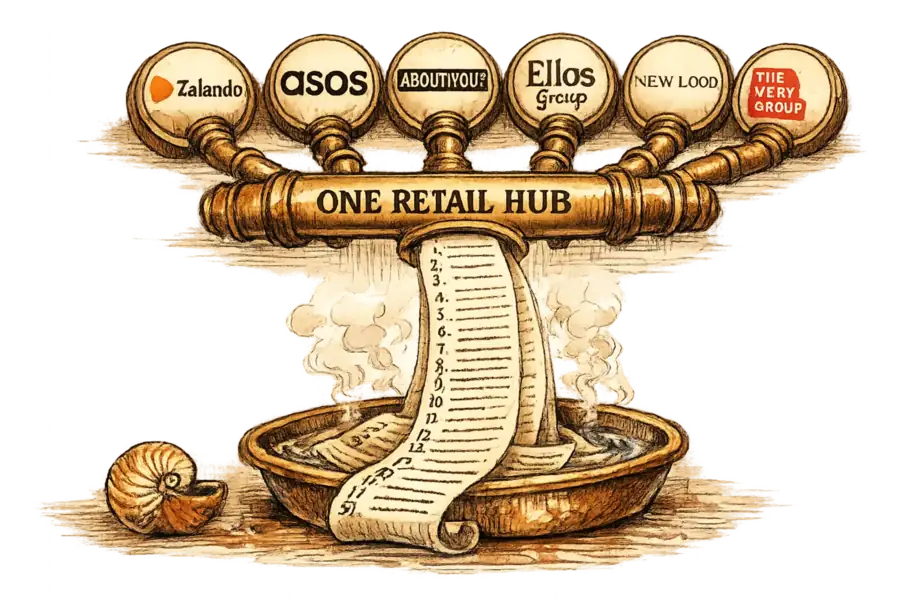
Seven European retailers have agreed, for the first time, that supplier due diligence is not a proprietary capability. Earlier this year, Zalando, ASOS, ABOUT YOU, Boozt, Ellos Group, New Look and The Very Group released a single 51-question Human Rights and Environmental Due Diligence form and a free platform, One Retail Hub, that collects the answer once and shares it across participants. The announcement said nothing about cost, but it is a repricing all the same: compliance has moved from the column of things brands compete on to the column of things they share. That reclassification lands hardest on brands that built their ESG identity on proprietary oversight.
The scale of the duplication being eliminated is the headline, not the tool itself. Pascal Brun, Zalando’s Vice President of Sustainability, told reporters that many existing tools had primarily increased administrative burden and slowed decision-making. Early users of the shared platform are reporting a 70% reduction in workload, according to TrusTrace, which co-developed the questionnaire with The Industry We Want and built the platform with Cascale and Fair Wear as launch partners. The 51 questions are grounded in the OECD Due Diligence Guidance for the garment and footwear sector, the reference document in the room for nearly a decade. What is new is that seven retailers previously insisting on different questionnaires for the same suppliers have agreed the difference was never worth what it cost.
The regulatory backdrop makes the timing legible on exactly one reading. Late in 2025, the EU’s Omnibus I package pushed back CSDDD compliance deadlines, narrowed the law’s scope, and reduced maximum fines. Brussels, in other words, spent the quarter before the launch withdrawing pressure on the exact activity these retailers then chose to centralise. The shared infrastructure is not a compliance shortcut forced by law; it is a decision to treat due diligence as plumbing even after the regulator stepped back.
Shared infrastructure collapses differentiation at the layer it covers. Payments, identity verification and cloud compute each flattened into a baseline once rivals agreed to consume them from the same pipe, and the vendors that had sold the layer as their identity had to find something else to be known for. The apparel analogue is tidier than usual because the 51 questions and their OECD grounding fix the definition: a brand’s answer is now comparable to its peers on the same scale, visible to the same buyers. Comparability is what kills a moat. Once comparison is cheap, the premium for being better than the average has to be earned in a way the questionnaire cannot measure.

The casualty is the brand that sold “we know our suppliers” as a reason to pay more. Reformation, Nudie Jeans, Veja and a generation of direct-to-consumer apparel houses built positioning on proprietary traceability — their own supplier lists, their own factory audits, their own oversight narratives published with enough granularity to signal care. Very few of them will lose the audit itself; what they lose is the fact that the audit used to be a thing only they did. A brand answering the shared questionnaire competently now looks approximately the same as a brand that spent a decade building in-house capacity. The buyer cannot see the difference without additional work the buyer is unlikely to do.
The best version of the counter-argument is that the 51-question form measures maturity, not outcomes, and a low-effort brand can pass a maturity test without doing the work underneath. That is correct, up to a point: self-assessment instruments reward process, and a firm willing to write plausible answers can clear a bar it has not met. The answer is that the moat was never in the form; it was in the difficulty of comparing brands on the same scale at all. A shared standard makes exaggerated claims cheaper to refute, because every brand now answers the same questions, and a claim that outruns its answer is visible to anyone checking. The maturity test is the floor, not the ceiling, and the floor is what unbundling lays down.
If two more of Europe’s pure-play retailers sign on, then the questionnaire becomes the de facto passport for selling on the continent, and the brands outside it will learn what Amazon’s third-party sellers learned around 2019: that platform rules can quietly become a more binding constraint than the ones written in statute.
What the retailers have done is announce that compliance is a utility bill. That classification strips it of the things brands used it for: a narrative, a differentiator, a reason to charge more. The brands that understood ESG as identity now have a choice they did not have in January — keep spending on proprietary oversight and find a new market for the story, or move the budget to something the 51 questions do not cover. The wrong response is to argue that the shared form is inadequate, because adequacy was never the contest; the contest was who had the capital to run the form at all. That capital requirement has just been removed, and the brands that relied on it will have to defend their premium on ground the questionnaire does not touch.