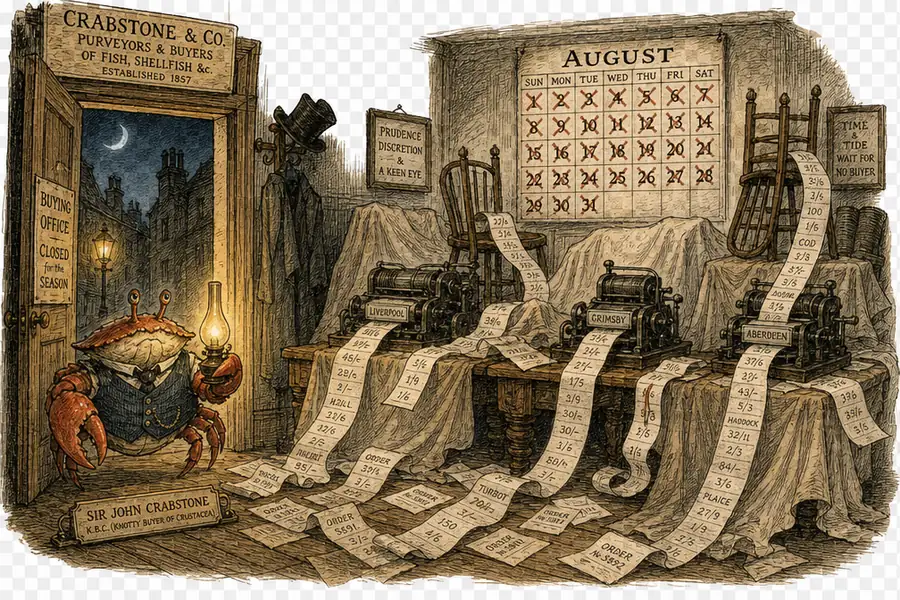
August Is a Human Convention. The Software Kept Ordinary Hours.
The trade's August pause is now observed by people alone. Pricing, ranking, replenishment and forecasting ran through it unread, and the autumn's misallocations were set in the four weeks nobody was at the desk.
Sir John Crabstone
The trade’s diary has no August in it. Milan’s womenswear shows resume on 22 September; the calendar between them and July is empty. Pricing, ranking, replenishment and forecasting worked the whole month. Only the people paused.
The received view is that this is precisely what the software is for: the business carries on while its people rest. It does carry on. RELEX, which sells the system, publishes a case study for Stockmann, the Finnish department store group, putting automation of purchase orders at 80 to 90 per cent. The pitch attached to that figure is that planners are left free for the exceptions. In August there were no planners. An exception queue is a control only while somebody opens it.
Search moved while the offices were shut. On 5 and 6 August more than a dozen rank trackers registered a reshuffle that Google had not confirmed, with site owners reporting traffic down by half and worse. No merchandiser wrote that week’s ranking, and none was at the desk to read it.
August is not an idle month in the ledger. Summer clears at whatever the markdown rules say it should, and the first fortnight of autumn sell-through is what the replenishment model takes for demand. A holiday-shaped fortnight becomes the basis of the reorder. The error is small in August and arrives in October at full size.
Forecasts do not hold still either. A 2022 study in Scientific Reports found temporal degradation in 91 per cent of cases across 32 datasets and four model families, drawn from healthcare, transport, finance and weather rather than apparel. The mechanism travels. A demand model last retrained in spring is not neutral about autumn; it is confident about it.
Prices answered one another all month. The first field study of algorithmic pricing was run on German petrol stations. Writing in the CPI Antitrust Chronicle, two of its authors report margins rising roughly 15 per cent after adoption, and nearly 40 per cent in small markets where every station took the software. Adopters matched a rival’s cut at once, while their response to a rival’s increase did not change at all. Fuel is not frocks. But an algorithm that meets a cut at once needs nobody’s approval, and for four weeks it had nobody’s attention.
Nothing was decided in August, and a great deal was settled.
Brussels legislated straight through it. The AI Omnibus entered into force on 27 July and pushed the AI Act’s high-risk obligations out to 2 December 2027. The transparency duties we flagged in July took effect on 2 August on schedule. A rulebook whose dates fall in the first week of August has already told you how closely it expects to be read.
The teams return this week to a season already positioned. Stock has been reordered against a model trained in spring, traffic redealt by an update nobody announced, prices settled wherever the systems left them. September will read these as decisions. They are attendance records.