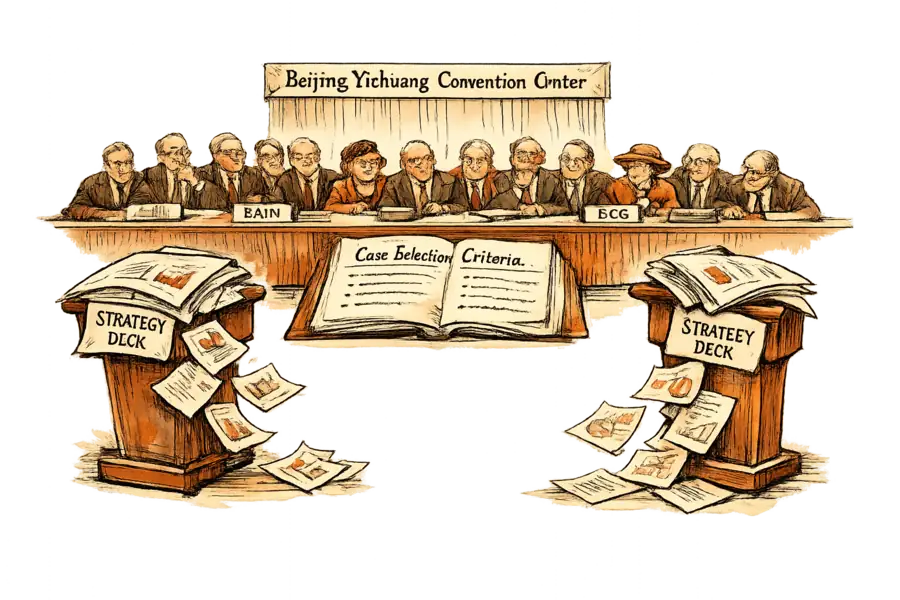
Bain and BCG Sat On 36Kr's Jury. The Criteria Wrote Down Their Deck.
36Kr's Beijing Yizhuang AI conference seated a fourteen-member jury that included Bain and BCG, then published case-selection criteria that quietly devalue AI fluency and pay for the scarcer thing — operational judgment on low-frequency decisions.
Neritus Vale
36Kr’s AI Partner conference convened May 19-20 in Beijing Yizhuang with a fourteen-member jury that included Bain’s Cheng Xin and BCG’s Yu Chenao, and the case-selection criteria both firms helped set quietly demote the thing they still bill by the slide. The standard for an “AI scenario penetration case” says penetration is not measured by “how cutting-edge the technology itself is” but by whether AI has been embedded in the core business process and produced “quantifiable and attributable business results.” Two consulting partners lent their names to a framework that pays for operational judgment and writes down AI fluency. The deck is the depreciating asset.
The criteria themselves are the proof, because they were set by people whose business model is harmed by them. Zou Ping, director of 36Kr’s research institute, named three jury signals: R&D and validation cycles compressed by an order of magnitude, human-machine collaboration deepened in practice with measurable gains in overall efficiency, and a substantive lift in product or service quality. Tan Yinliang, the CEIBS decision-science professor on the same jury, added a four-part definition of depth: AI must enter critical decisions and trigger actions, form a complete data-decision-execution-feedback loop, attribute business outcomes at unit level, and integrate into the system layer rather than remain a surface-level tool. Nothing in either checklist asks how large the model is, which architecture won, or whose strategy deck framed the rollout. The questions all sit downstream of model choice, in the layer most consulting practices charge for as a separate engagement after the model has already been picked.
The scarcity the jury named is the operator who can tell which decisions are worth the loop.
Model knowledge depreciates because foundation capability has commodified — DeepSeek, Qwen, Zhipu and Kimi now operate at capability levels buyers were paying premium prices for two years ago — and the jury’s criteria reward what that shift left scarce. Last year’s prompt-engineering arbitrage compresses into a managed feature inside the next release. Operational judgment on low-frequency decisions does not depreciate, because the underlying problem is not solved by faster inference: when to reprice a category, when to reroute inventory, when to escalate a compliance review. The 36Kr criteria reward “unit-level business metric attribution” precisely because that attribution requires somebody who already knew the unit economics before the model arrived. Zhang Yun of Model Speed Space, on the same jury, wrote in the pre-conference announcement that most AI pilots fail to scale because “business process and organizational structure did not adjust in sync, not model technology.” That both Bain and BCG still offer engagements built around “AI strategy” as a distinct deliverable makes the framework harder to dismiss as neutral.
The pattern is visible elsewhere in 36Kr’s own coverage. A 36Kr profile of WPS’s office AI launch opens with what the journalist calls the “smart trap”: products that “understand instructions but can’t execute work.” Yang Ding, WPS’s product lead, told the launch room his firm “distills not people, but industry know-how.” Two different 36Kr forums, with different sponsors, arrive at the same shape of finding: model parity is baseline, vertical workflow knowledge is the moat, and the person who can codify a domain’s quiet conventions is more expensive to replace than the person who can pick the right model. The conference’s own press materials say its purpose is to “secure a group of scarce talents who understand both AI and the industry.” The conjunction is doing the work in that sentence.
The obvious objection is that consultants always reframe their pitch a cycle ahead of the buyer, and this is just the next rotation of the same playbook. For the objection to hold, the published criteria would have to be marketing theatre — used to win the engagement, ignored once the slides start. The countervailing fact is that the criteria were also set by Tan, a working academic, and Zou, who runs the research arm against which the conference’s own selections will be judged in print. A standard that an academic and a research director will be measured against in print is one that survives the engagement. The strategy deck does not survive that audit, which is why it is the thing depreciating.
The price for getting this wrong is the structure of the deliverable enterprises are still buying. An enterprise paying for a 2026 AI strategy deck is buying a wasting asset, because every criterion at the 36Kr jury says the work that survives is the embedded loop, not the framework. If those criteria become the standard, the firms with durable margin are the ones that can audit a process, identify the low-frequency decision worth instrumenting, and stay long enough to close the feedback loop into the next quarter. That capability lives in operators who already understand the unit, not in vendor demos or horizontal decks. The jury at Yizhuang did not say AI knowledge is worthless. It said it is no longer the part that is scarce, and a jury saying that in print is the part the room was meant to remember.