Betty Barclay Bought the Right to Change Its Mind Mid-Season
Chainbalance put Betty Barclay's wholesale merchandising chief on a webinar to argue that slow processes, not slow decisions, cost margin in season. A vendor selling reaction time instead of forecast accuracy is telling you where the gains in prediction ran out.
Neritus Vale
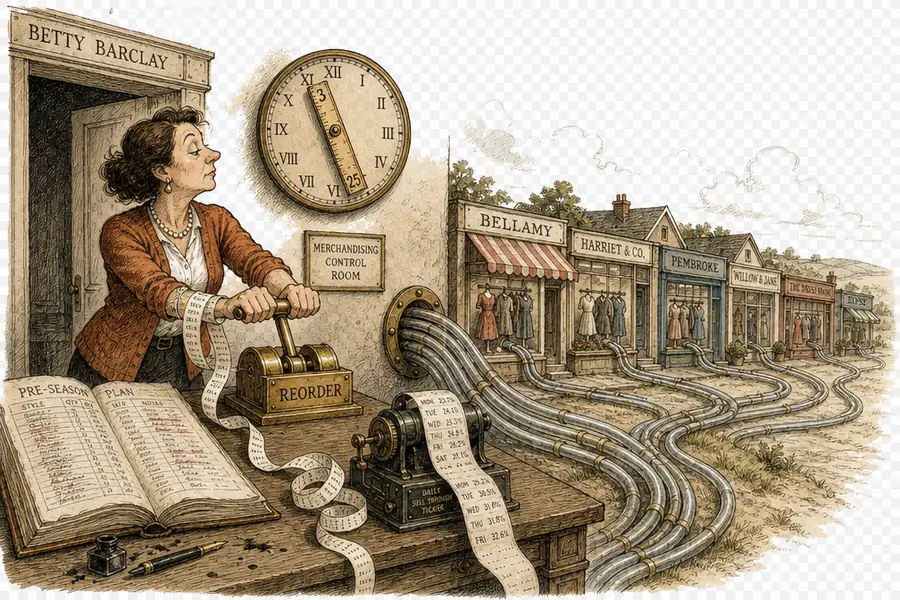
Chainbalance spent its September webinar arguing that the problem with in-season merchandising is slow processes rather than slow decisions. The vendor brought Andreas Lachmann, head of merchandising for wholesale and depot at the Betty Barclay Group, to make the case, and offered a “3-to-25-day replenishment gap” as its proof, in a partner-content post on FashionUnited. That is a merchandising vendor selling reaction time, in a category built on selling forecast accuracy. The money has moved from reading a season correctly to shortening the interval between a sell-through signal and a reorder. Betty Barclay did not buy a sharper view of autumn. It bought the right to change its mind about autumn halfway through.
The order in which Betty Barclay bought its systems is the clearest evidence for that reading. In April 2023 the group selected Board for merchandise financial planning, pulling its labels, markets and wholesale channels onto one platform. Planning was the cheaper problem to solve, because it is arithmetic performed once, before the season, on assumptions nobody can test yet. What it displaced was more than 600 Excel spreadsheets, which tells you the constraint being lifted there was clerical. Chainbalance arrived to do the thing a plan cannot do, which is revise itself. By February 2025 the group’s director of merchandise management was describing a finished pilot and a first year, with Lachmann reporting that “speed has improved significantly”.
Pre-season accuracy is hard to sell because it is hard to improve. In the M5 competition, the largest public test of retail forecasting and the subject of a 2022 paper in the International Journal of Forecasting, thousands of entrants were handed years of daily Walmart transactions, and only 7.5 percent of them beat a plain exponential smoothing model reconciled from the bottom up. The organisers also found the leading methods losing accuracy as the data got finer, with the product-store level the hardest of all to predict. That is the exact level at which a replenishment decision is taken. The winning team did beat the benchmark, by 22.4 percent, which is a real gain and the output of a global contest optimised for nothing else.
M5 is the friendly case for forecasting, and fashion is the hostile one. Supermarket and household lines carry years of history behind every prediction, while a Betty Barclay dress arriving in an independent boutique in week three of autumn carries none. Whatever ceiling holds on clean data sits lower on sparse data, and the comparison runs in one direction only. The marginal euro therefore moves to whatever else can still change the outcome.
Prediction is what a vendor sells when it cannot promise speed.

The insight Chainbalance is selling was settled thirty years ago, which is the part the webinar leaves out. Marshall Fisher and Ananth Raman modelled quick response at a major fashion skiwear firm and reported in Operations Research in 1996 that optimising the reaction to early sales cut costs by enough to raise profits by 60 percent against the firm’s existing informal practice. Their argument was never that forecasts would improve; it was that part of the buy should be withheld and committed against the first real demand the market produced. What kept that from becoming standard practice was the cost of running it. Doing it properly means re-deciding at the level of one SKU in one door, every day, and that was a labour problem before it was a mathematical one. Chainbalance sells exactly that labour, promising “millions of micro decisions” daily and an 80 percent cut in workload.
The strongest objection is that Betty Barclay bought both halves and conceded nothing about prediction. Board plans the season, Chainbalance corrects it, and Chainbalance does sell prediction too, under the names Smart PO Forecast and Smart Demand Forecast, though Betty Barclay’s own stated goals for the partnership include precision in replenishment, not just speed. For the argument here to fail, pre-season accuracy would have to be improving quickly enough that the next euro belongs there rather than in cycle time. Look instead at what each supplier is willing to be measured on. Board’s case study counts spreadsheets retired and how fast the data loads; Chainbalance leads with workload, overstock and turnover. Neither contracts on forecast error — and a vendor who had moved that number would lead with it, because it is the only figure a merchandiser can carry into a board meeting without translation.
The re-decisioning Betty Barclay bought happens on other people’s floors, which is where its cost sits. Lachmann’s title names the two channels, wholesale and depot, in which the brand rather than the shopkeeper decides what stays on the rail. A daily reorder taken centrally is a decision an independent retailer used to make, and the system pays only where those partners accept the transfer. This is the same group that was an early enterprise customer for SCAYLE STUDIOS, the tool ABOUT YOU built to take content production from weeks to minutes. What Betty Barclay keeps buying is a shorter gap between noticing something and acting on it.
The factory sets the ceiling on what this purchase is worth. Quick response only works if the reorder can be made and delivered inside the season it was meant to rescue, which is the condition Fisher and Raman built their model on and the one no dashboard supplies. If lead times stay where they are while every competitor buys the same daily decision engine, the gain resolves into a faster queue for the same capacity. That shows up as lower workload, which is worth having. It is not an advantage. The choice in front of merchandisers is where the next euro goes: into the system that detects the signal, or into the supply that can answer it.