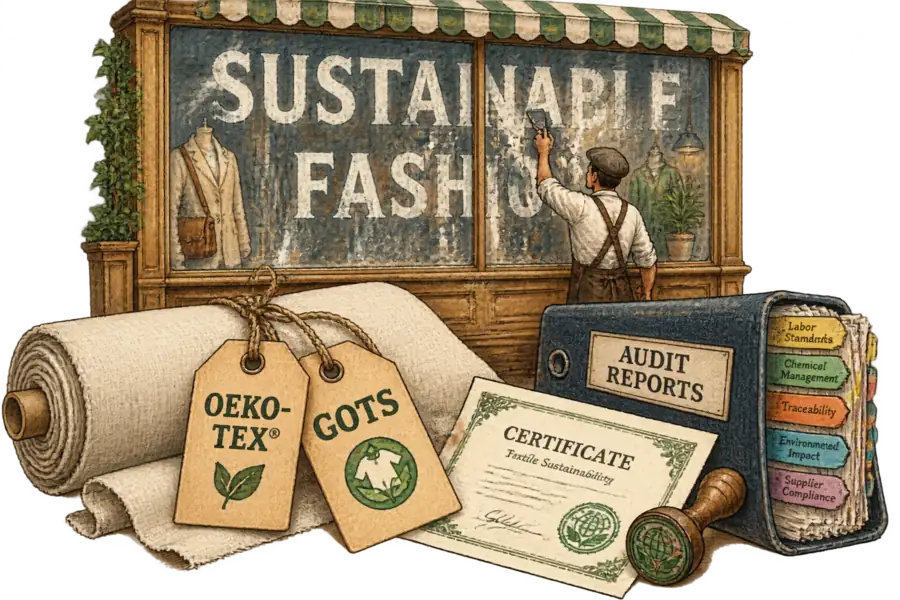
Brands Went Quiet on Sustainability. The Certifier Kept the Receipts.
Greenhushing looks like a loss of conviction and is a loss of standing: from 27 September, EU rules bar any sustainability label that no certification scheme backs. The claims did not disappear. They moved to the certifiers, whose volumes are rising while brand messaging falls.
Sir John Crabstone
Fashion did not stop believing in sustainability. It stopped being permitted to say so on its own authority. Brands have grown reluctant to discuss their environmental progress in public at all, deterred by regulatory scrutiny and by a run of greenwashing accusations. FashionUnited put the case to Oeko-Tex’s chief executive on Friday. The conviction is intact; what has lapsed is the standing to assert it unaided.
The usual diagnosis is a failure of nerve. Thirty-six per cent of consumers recalled seeing sustainability messaging last year, against 49 per cent in 2023, and trust in those messages slipped from 74 per cent to 65. The survey covers more than 30,000 people in 31 markets, and it prescribes more communication, better aimed. The prescription assumes the silence is voluntary.
Compulsion arrives on 27 September. Directive (EU) 2024/825 makes it an unfair commercial practice anywhere in the Union to display a sustainability label that is not based on a certification scheme or established by a public authority. Words such as green and sustainable are barred outright unless the seller can demonstrate recognised excellent environmental performance. A label with no scheme behind it comes off the garment. None of this can be drafted. It has to be issued.
Silence has an arithmetic. Misjudging a claim risks a fine of up to 4 per cent of annual turnover in the member state concerned, and more where national law permits. Compliance with a label’s scheme must itself be verified by an outside party. Copy has never been priced this highly.
What a brand believes remains its own affair; what it may say now belongs to whoever can prove it.
The proof trade is expanding while the messaging contracts. Global Standard certified 17,800 facilities in 2025, 15.3 per cent more than the year before. The standard now reaches 95 countries, and 59 per cent of the firms it surveyed said certification had brought them new business. Its managing directors, Claudia Kersten and Rahul Bhajekar, put the change without ornament in their joint preface: voluntary sustainability standards have turned “from ethical labels into operational tools.” A label that once flattered a brand is now a document its buyer requires.
Oeko-Tex counts the same trade from the other end. Its 2024/25 annual report records more than 57,000 certificates issued, 8 per cent above the year before, with the Made in Green label on over 18,000 products. Every one of them is a file somebody may be asked to produce. The marketing department was never obliged to keep anything.
On 19 August the certifier rewrote its own constitution. Oeko-Tex is converting its operating company into a public limited company, installing an Independence Council under a new statute, opening an anonymous whistleblowing channel and aligning its accreditation with ISO/IEC 17065. The testing itself does not change. Its chief executive, Alfred Beerli, gives the reason: “Consumer protection begins with trust, and trust only arises when what is claimed is independently verified.” No brand was ever required to prove it was independent of its own claims.
The evidence trade polices itself more strictly than the marketing department ever did. Global Standard investigated 25 fraud complaints last year and placed twelve entities under a certification ban. Fashion has found a party willing to be answerable for its claims, and has quietly made that party’s competence the whole of its credibility. It has not yet asked what happens the day a registry is wrong.