Chalhoub Joined Copenhagen One Tier Below Its Suppliers
Chalhoub Group has joined Global Fashion Agenda as an Associate Partner, a tier below the houses whose goods fill its shops. Ninety-four percent of its purchased-goods emissions sit with a hundred suppliers it does not own, and Brussels' due-diligence law will reach those houses years before it reaches Chalhoub's own supply base.
Sir John Crabstone
Chalhoub Group has joined Global Fashion Agenda as an Associate Partner. The Gulf distributor has acquired a due-diligence vocabulary for a supply base it franchises and does not own. The questions are coming from Paris rather than Brussels, and it has no standing to answer them.
The partnership is not this week’s news. GFA announced it in May at the Copenhagen summit, in a session titled “Building the Future: From Leadership to Legacy.” The trade has run it again this month with the Planet FWD framework attached.
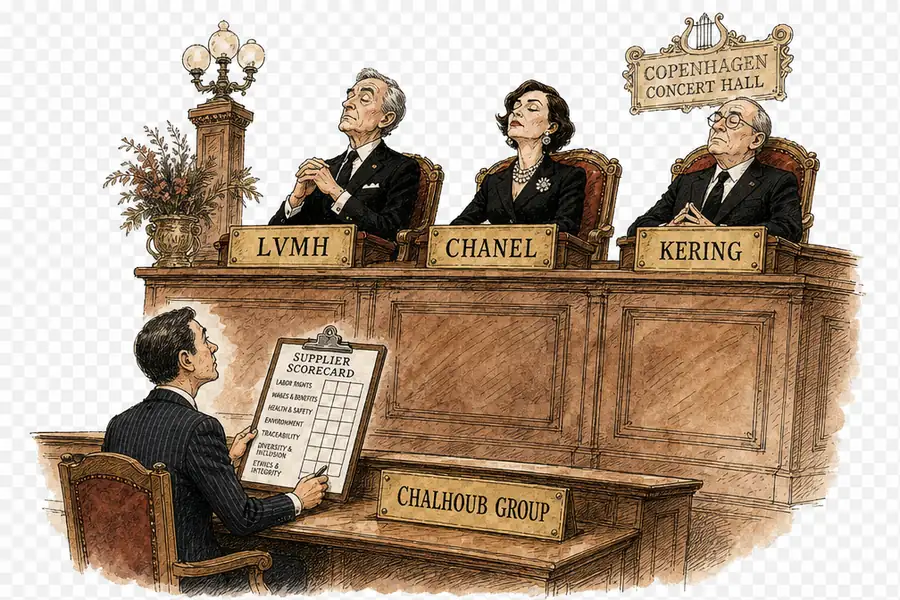
Read the seating. GFA’s partner register places Kering, Chanel and LVMH in the Strategic tier and Chalhoub a rung beneath, among the Associates. The houses whose goods fill its shops were in the room first. The suppliers whose emissions data Chalhoub needs sit off that register entirely, unnamed even in its own disclosures.
Neither side has said what the partnership costs. WWD’s Sourcing Journal notes that Chalhoub and GFA have disclosed no financial commitment, no partnership term, no specific joint project, and no performance targets. The vocabulary arrived before the substance did.
The model explains the difficulty. Chalhoub, a major player in Gulf luxury retail by trade-press accounts, has run Sephora regionally as an LVMH joint venture since 2006, franchises other houses, and owns a few brands outright. It takes title to the goods. It never takes title to the factory.
Its own accounting concedes the point. Ninety-four percent of the Group’s purchased-goods emissions come from a hundred suppliers, and the programme built to reduce them is called Brand Partner Sustainability Engagement. The name identifies the counterparty with some precision.
Brussels is in no hurry either. February’s Omnibus directive trimmed the bloc’s due-diligence law to companies above 5,000 staff and €1.5 billion in turnover, and set one compliance date of 26 July 2029. Non-EU groups are reached only on turnover earned inside the EU. The directive draws no line between direct suppliers and the layers behind them, having rejected proposals that would have narrowed it to first-tier partners. So the duty lands on the houses, and the questionnaires land on whoever runs their shops.
WWD’s Sourcing Journal reads this as a Scope 3 problem, which is nearer the mark than the rest of the trade managed. It is not the whole shape of it: investments, not purchased goods, generate the larger share of that footprint, forty-seven percent against thirty-one. The jurisdictional problem doesn’t shrink for it. The emissions behind that thirty-one percent still belong to companies Chalhoub cannot audit and Brussels will not regulate on its behalf.
Federica Marchionni called seventy years of Gulf trust “leverage.”
The word is right — the direction is not.
That leverage points at malls and consumers, where Chalhoub is formidable; due diligence runs the other way, toward a supply base where it is a buyer and not an owner. The vocabulary fits the malls and the shops already. It does not yet fit the factories it buys from, and Brussels’ 2029 deadline will not wait for it to catch up.