A Dermatologist's Name Is the One Asset a Model Cannot Generate
A dermatologist, a makeup artist and a hairstylist described the same conversion on a Glossy POP stage last week, while Puig agreed to pay €1.2 billion for the half of Isdin it did not own. Formulation, packaging and imagery all have suppliers; a licence does not.
Sir John Crabstone
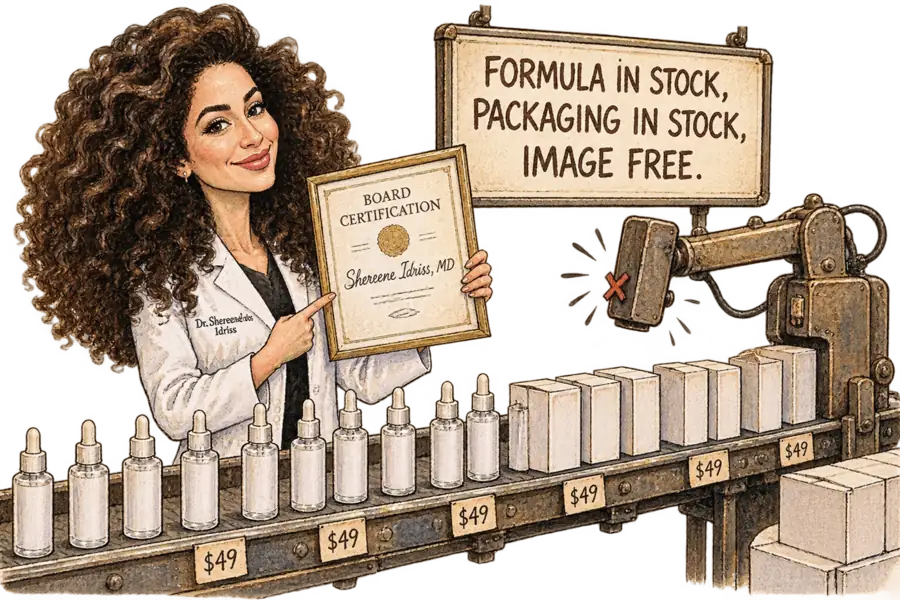
Everything in a beauty launch can be ordered from somebody else. The formula has a contract manufacturer, the tube has a component catalogue, and the image is now the cheapest thing in the process. Only the name on the front has no supplier, which is why it is the part being bought.
Three practitioners described the same conversion at Glossy POP in New York last week: a dermatologist, a makeup artist and a hairstylist. Mara Roszak had twenty years behind the chair and “not a clue” how to build a business; Mary Phillips had spent years “hoarding” her underpainting technique. Dr. Shereene Idriss spent about two and a half years developing her line before launch. The expertise was finished before the company existed.
The trade reading is demand-side: shoppers want credibility in a crowded aisle. That is true and insufficient. It explains why the products sell, not why a group with its own laboratories would rather buy a credential than hire one.
Two and a half years is the quick part. A dermatologist arrives with more than a decade of training behind the licence: four years of college, four of medical school, a year of internship, three years of residency. A contract manufacturer will return the call this week.
A model will render the white coat and the clinic behind it, but not the board that issued the licence.
Acquirers price this correctly. Puig will pay €1.2 billion for the half of Isdin it did not already own, €900 million of it in cash at closing. What it is buying is the counter where a pharmacist repeats what a dermatologist said.
Set the price beside Puig’s own accounts. Isdin sells sunscreen through pharmacies. Skincare is the smallest of its divisions, 11 percent of a €5.2 billion year. The cheque for Isdin is worth more than two years of that division’s sales.
The smaller deal that week says the same thing more plainly. Caudalie made its first acquisition and took majority control of Talm, a brand that began in pregnancy and postpartum care. Founder Kenza Keller stays as chief executive. Nobody pays for a dozen products; they pay for the reason a pregnant customer believes them.
Puig bought an institution, which cannot resign. Every other buyer here is acquiring a person, and the licence goes home with them.