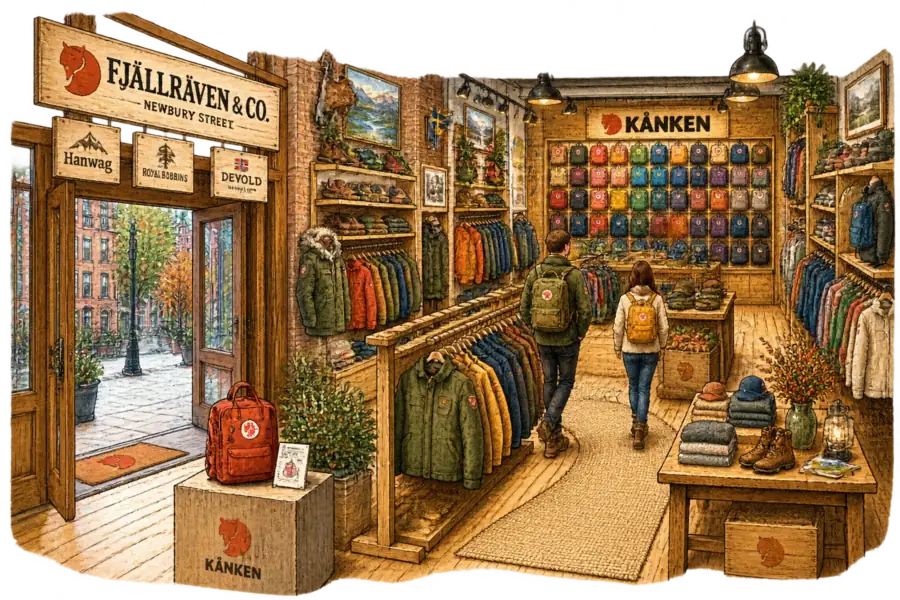
Fjällräven Put the Kånken at the Back. That Is What the Store Is For.
Fjällräven's new Boston shops keep the Kånken behind everything else the company makes, and the sister brands get shelf space next to it. Sequencing like that is only available on a floor plan; every ranked surface the brand sells on hands back the one bag it is trying to grow past.
Sir John Crabstone
Fjällräven’s new shop on Newbury Street keeps the brand’s most famous product at the back. The Kånken sits by the door as a teaser. The wall of them waits behind every jacket and trouser the company makes, as Modern Retail reported from Boston. A shop is the last surface Fjällräven controls the order of, and every ranked page it sells on hands back the bag it is trying to grow past.
Nathan Dopp, who runs the Americas business, wants stores that feel “a little bit like a nature trail or a river”. He dislikes straight lines. There are more than 30 of them in North America now, producing between 24 and 30 percent of regional revenue. The romance is sincere and beside the point: a curve is a device for deciding what a customer sees second.
Two shops opened on Newbury Street this month, a brand store at 165 and Fjällräven & Co. at 304, the second stocking Hanwag, Royal Robbins and Devold beside the parent. Those three sister brands carry little pull of their own. Shelf adjacency is the cheapest distribution they will ever be handed, and it exists only where there is a floor plan to put them on.
No search box has ever introduced anyone to a Norwegian wool company they were not already looking for.
The narrowing is documented. Recommender systems were built on a promise to lift the long tail. A survey of the literature, first circulated in 2023 and updated through 2024, finds they concentrate on already-popular items instead, with reinforcement effects that compound over time. That review covers recommenders in general, not outdoor retail. The transfer is clean enough: ranking rewards whatever already sells, and what already sells here is a schoolbag from the 1970s.
Machines are not the only offender. Half of Fjällräven’s North American sales still move through wholesale, where a human buyer sets the assortment, and buyers reorder what cleared last season. A ranking model and a merchandise buyer arrive at the same list by different routes. The company’s own floor is the one place where somebody is paid to make the harder call.
The bill lands in a thin year. Fenix Outdoor, the parent, posted €707.7m in net sales for 2025 and kept €5.3m of it after tax, down from €14.6m the year before. Whether the walk to that back wall sells anything on the way is the figure that matters, and it is not one Fenix publishes.