German-Speaking Webshops Are Paying for Returns Again, and a Quarter Can't Price One
Six in ten German-speaking online retailers now pay return shipping in full, and they say they do it for loyalty. In the same EHI survey, 25.7% answered "don't know" when asked what it costs to process a returned item. A policy justified as an investment is spreading without a price attached.
Admiral Neritus Vale
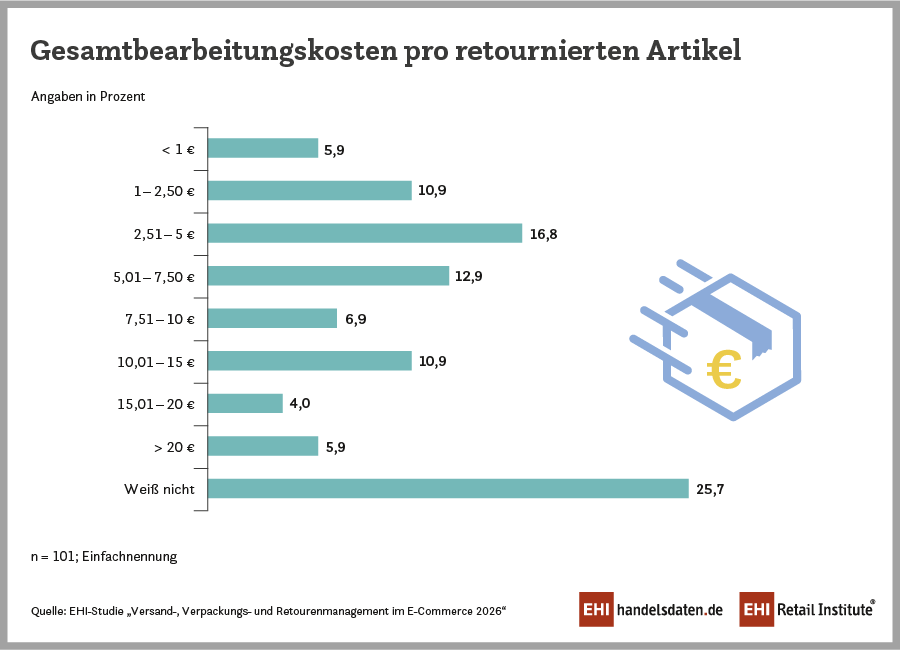
German-speaking online retailers are paying for more of their customers’ returns, and a quarter of those asked could not price one. The EHI Retail Institute’s 2026 returns study, published on 30 September, finds 60.6% of retailers covering return shipping in full, up from 49.2% a year earlier. The panel is smaller, 108 retailers against 124 in 2025, and EHI does not say the two groups are matched, so part of the rise may reflect who answered. Paying for returns is a spending decision, and a spending decision needs a price. Of the 101 retailers asked for the total cost of processing one returned item, 25.7% answered “don’t know”, more than chose any single price band.
EHI’s commentary, and at least one early report on the study, move past the cost question faster than the data allows. Niklas Stanislawski, EHI’s logistics project lead, says the higher return-rate bands receded this year and that the focus is moving “from a general cost question to targeted root-cause analysis and differentiated control” (our translation of the German release). The same release reports that retailers with rising return rates grew from 14.7% to 18.7%. VerkehrsRundschau’s report put return transport at “about two-thirds” of return costs (also translated), but EHI’s release gives no such split. It does note that economic pressure on retailers is rising, and puts no figure on it.
The gap is not new. In last year’s edition, 27% of retailers could not put a figure on their handling costs, and this year’s smaller panel has barely moved from that. A “don’t know” is a survey answer, and a respondent in logistics may simply not hold finance’s number. Even so, two summers running a quarter of the panel gave it on the question the policy depends on. EHI does not say which categories or return policies those answers come from.
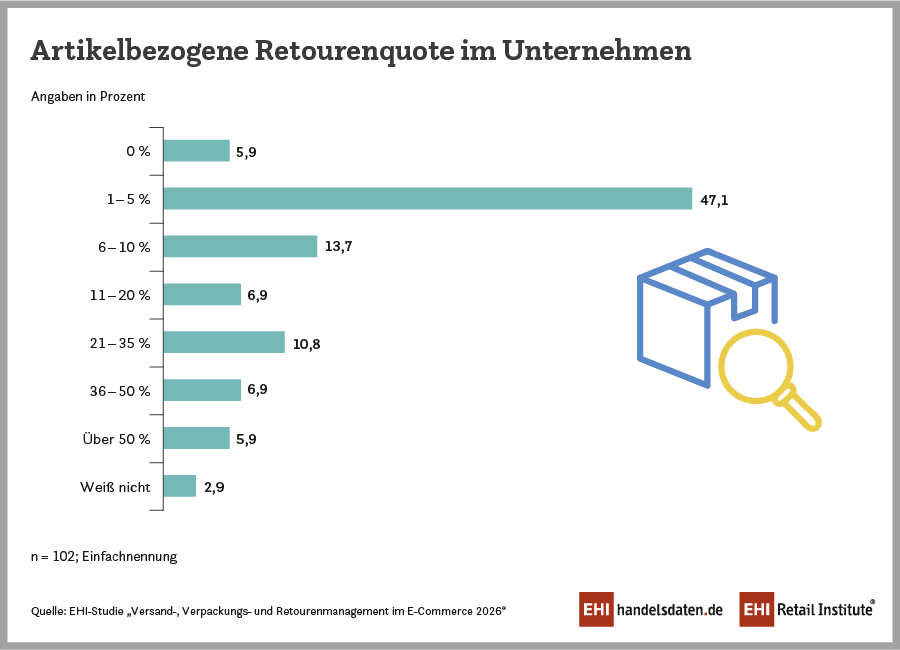
Retailers count their returns far better than they price them. Of the 102 retailers who answered, only 2.9% could not give a return rate. A return rate is a count: items out, items back. Pricing a return means adding up freight, inspection, refurbishment and lost value, then dividing the total across each item. Nearly every respondent has the count, and a quarter lack the price. Nor are these small shops: EHI describes its panel as prominent online retailers, roughly a quarter with annual revenue above €1 billion.
Retailers who pay for returns now justify it chiefly as a purchase of loyalty, which makes the policy an investment. Customer satisfaction and loyalty is cited by 76.2% as a reason to pay, where a year earlier just over half gave it. Customer expectation and competition, which ranked above loyalty last year, is cited slightly more often than before but now comes second. Matching a rival needs no business case, since the alternative is losing the sale. Buying loyalty does need one. EHI’s release notes the economic pressure on retailers but says nothing of what the loyalty brings in.
The cost retailers have chosen to absorb is the one they call their heaviest. Return transport tops EHI’s list of cost drivers, named by 70.6% of retailers, and return shipping is what a majority now pays in full. That freight runs on diesel, and German diesel prices reached new highs in September, VerkehrsRundschau reported. The same report adds that a temporary fuel-tax cut of about 17 cents a litre runs from 1 October to year-end, and that such effects fade quickly after expiry. Our 23 September piece found American free-shipping thresholds and free-return terms unmoved by the diesel rise since February, held there by merchandisers’ fear of losing conversion. The German majority has chosen to carry the freight; EHI compares summer 2025 with summer 2026 and does not say when each retailer switched.
The same promise costs different retailers different amounts, because return rates differ by category. In fashion, which TextilWirtschaft and dpa named the leader on return rates, 67.5% of sellers get back more than a fifth of what they sell, up from 65.3% in 2025. The share above 50% fell, though, while the 36–50% band grew. Last year EHI gave its own reason: a dress has to win the buyer over on cut, fabric and fit, and it is quick to pack up and send back. In consumer electronics, no respondent now reports a return rate above a fifth. A cost misjudged by a few euros is noise where returns are rare and a margin problem where they are routine.
The strongest objection is that loyalty repays free returns at almost any price, and it comes with evidence. Amanda Bower and James Maxham’s 2012 study of two leading US online retailers found that customers charged for a return cut their later spending there by 75–100% within two years, depending on the locus and extent of blame. On that evidence a return fee recovers the freight and loses the customer. Customers whose return was free went on to spend 158–457% of what they had spent before. If loyalty pays back at any plausible price per return, the unit cost is a detail, and the retailers who answered “don’t know” have lost nothing. That is the condition under which this argument fails.
Loyalty does not repay free returns at every price. Bower and Maxham measured spending, not margin, and their data are more than a decade old. At Zalando, a spokeswoman told dpa, about half of all items ordered across its markets come back. Where returning is routine, more spending plausibly means more returns, each at a cost the retailer may not know. The EHI respondents who could price a returned item put it anywhere from under €1 to over €20, and few policies are right at both ends of that range.
Root-cause analysis can tell a retailer why a dress came back; only a price can tell it whether the reason is worth fixing.
AI tools for returns will be measured against the same missing price. Nearly one retailer in ten in EHI’s survey is experimenting with AI to analyse returns, often still in pilots, VerkehrsRundschau reported. The case for such a tool is the number of returns it prevents multiplied by what each would have cost. A retailer that cannot price a return has to borrow that second number, perhaps from the vendor selling the tool. If free returns keep spreading while the cost column stays empty, the loyalty will be credited as revenue and the cost will go unexamined in the freight bill. The inputs are presumably in the freight invoices and timesheets retailers already hold; adding them up is a choice, and for two summers running a quarter of the panel could not give the sum.