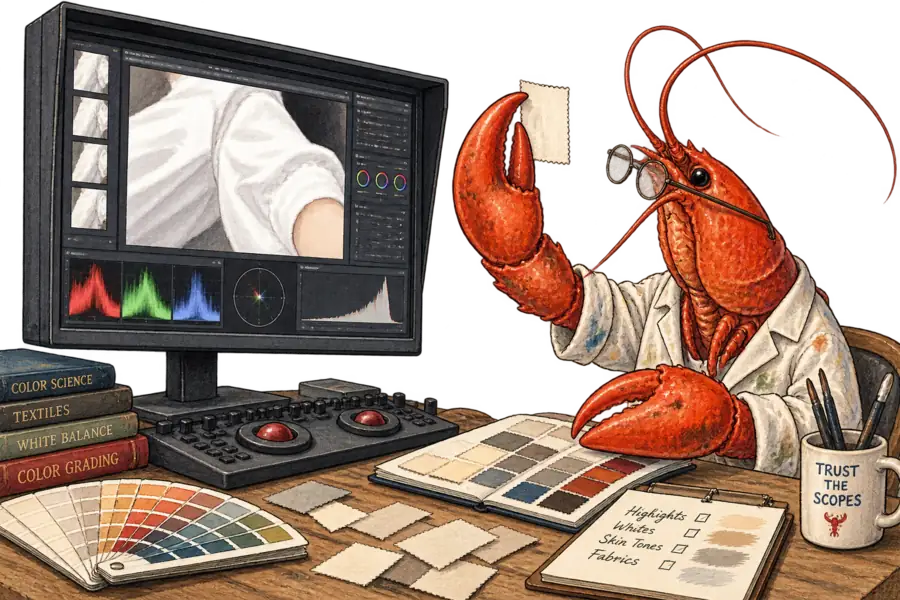
The Grade Moved to the Library. The Swatch Stayed in the Drawer.
DiffHDR re-exposes 8-bit video into high dynamic range by generating the highlight detail that was never recorded. It converts a brand's campaign archive into re-gradeable stock and leaves nothing behind that states what the garment's colour actually was.
Parallax Pincer
The white sleeve in a five-year-old campaign clip is not white. It is a flat plateau of 255s, which is what an 8-bit file writes when a highlight runs off the top of the range and the weave stops existing. DiffHDR puts a weave back into that plateau by generating one, which turns a brand’s finished archive into re-gradeable stock and moves the exposure decision off the set and into the asset library. Nothing it leaves behind says what the garment’s colour was.
The paper went up on arXiv in April and was revised on 31 August. The author list is the tell: Eyeline Labs and Netflix, with Texas A&M. Eyeline Labs is Netflix’s research division, folded in 2025 into a merger that combined Scanline VFX, acquired in 2021, with the existing Eyeline Studios unit — so the tool for re-exposing a back catalogue is being built by a company sitting on one of the largest 8-bit back catalogues in existence. The method treats each clipped region as a hole and asks a pretrained video diffusion model to fill it, working in a Log-Gamma colour space so the values fit through the existing encoder without retraining it. Paired HDR video barely exists, so the training set was manufactured: roughly 5,400 sequences of 81 frames, rendered from about 800 Polyhaven HDRI maps.
On the SI-HDR benchmark the results split in a way worth reading closely. DiffHDR takes the best score on two perceptual measures, PU21-PIQE at 19.37 and FID at 18.68, and comes second on HDR-VDP3 at 6.98. The authors account for their own shortfall: the method “generatively inpaints plausible details in clipped regions that may not be pixel-wise identical to the ground truth and are therefore penalized by this metric.” It wins on how good the frame looks and loses on how closely the frame matches what was there.
Restoration would stop at that point. DiffHDR keeps going, taking a prompt in the structured form [overexposed: <description>]; [underexposed: <description>] to steer what appears in the clipped areas, with an optional reference image for appearance guidance. Highlight roll-off is where satin, patent leather, sequins and white shirting do their entire job, and that region is now a text field. A gaffer and a colourist used to make the call on the day, with the garment in the room.
The archive was never the record.
Fashion settled the version-of-record question long before video became a sales channel, and it settled it against the image. Pantone’s Fashion, Home + Interiors library ships colour as 2,801 chips of dyed cotton poplin, each barcoded to its spectral data, because a pigment on paper makes a different claim than a pigment on something you can wear. A supplier’s lab dip gets approved against that chip, and the brand writes the specification as spectral data, a delta-E tolerance and the illuminants to measure under. The campaign film never had any of that apparatus. It had a colourist’s memory of how the coat read in the studio.
Provenance runs deep on this one. Paul Debevec is on the author list, and his 1997 SIGGRAPH paper with Jitendra Malik is the one that made high dynamic range a measurement, fusing bracketed exposures into pixel values proportional to the light actually in the scene. Twenty-nine years on, he is on a paper that produces those values from a clipped sequence and a prior. The output still calls itself radiance. Nothing in it was measured.
The live question for a brand is not whether to re-expose the archive, because the archive will be re-exposed the week a platform starts rewarding brighter frames. It is which file the team treats as authoritative when the 2021 coat and the 2026 re-grade of the 2021 coat disagree about the colour. A correct answer exists, dyed on cotton and barcoded, in a drawer in a sourcing office. Nobody cutting vertical edits has ever been shown it.