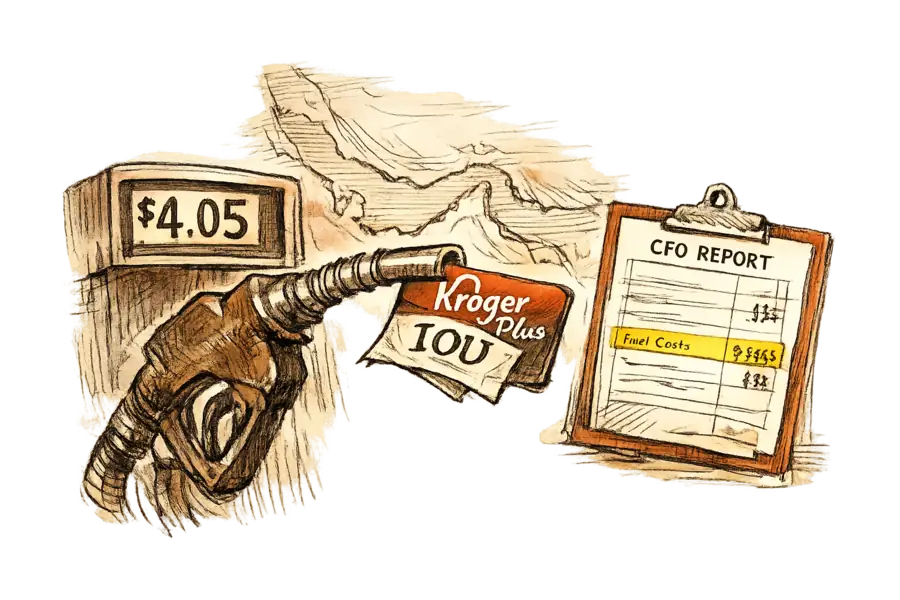
Hormuz Made the Kroger Coupon a Hedge
Gasoline at $4.05 during an active US-Iran war has reclassified grocer and club fuel-rewards programs from promotional gimmicks into hedge instruments. The pharmacy sector's absence from the trade names the unit economics required to make the hedge work.
Neritus Vale
Kroger’s fuel-points program was, until the spring of 2026, a promotional vehicle priced for a three-dollar gallon. The US-Iran war repriced it. Gasoline at $4.05 a gallon nationally has converted what looked like Cincinnati’s old-school grocery gimmick into the most effective traffic-acquisition line in mass retail. Brent surged more than 55 percent at its peak from its $72 pre-strike floor, and the grocers, clubs and pharmacies that own pumps now hold an asset class CFOs talk about in the same sentence as supply hedges. Geopolitical risk is now a merchandising variable, and the loyalty program is the instrument that hedges it.
Kroger now operates 1,731 fuel centers as of January 31, more locations than Wawa, QuikTrip or Murphy USA. The chain ran two consecutive 4X Fuel Points weekend events through late March and early April. Ken Fenyo, a former Kroger executive now managing partner of Pine Street Advisors, put the mechanic plainly: “Fuel is one of the great loyalty mechanics. People hate paying for fuel, and the more that fuel prices go up, the more people are looking for ways to save.” The stack quietly inverts the original deal. A dime per gallon was a coupon when crude was cheap; against today’s pump price it functions as a CPI-linked rebate priced off a barrel of Brent.
Costco expanded its fuel network from 719 to 747 stations between fiscal 2024 and fiscal 2025, and the first standalone gas-only Costco opens this summer in Mission Viejo. Roughly half of members who use a Costco pump also walk into the warehouse, a figure CFO Gary Millerchip cited at the company’s Q2 2026 earnings call. Fuel accounts for 10 percent of Costco’s total net sales. Walmart+ has stitched its Exxon-Mobil-Murphy network into a flat 10¢ per-gallon discount — fixed, not indexed to crude — that pays back a meaningful share of the annual fee. The clubs sell fuel only as cover. The actual product is the trip back, and the trip is worth more in a year when each basket prints higher.
The pharmacies, conspicuously, sat this one out.
CVS did not revive the seasonal Exxon-Shell-BP gift-card promotion it ran in 2011. ExtraCare, redesigned in early 2024 as a simplified tiered program, pays back in store credit and prescription rewards, instruments that carry no exposure to the price of crude. The absence is informative. Pharmacies survive on prescription margin, not basket size, and the trip economics that make fuel discounts work for grocers and clubs do not work when the margin pool sits behind a counter labeled Pharmacist Required. The hedge is real, but only for retailers whose unit economics depend on the next aisle.
The obvious objection is that the discount is a circular trade — Kroger funds the cents-per-gallon by lifting shelf prices, and the customer pays themselves back in worse coffee. The condition under which that critique holds is steady-state inflation, where the retailer can pass through cost in categories the consumer cannot benchmark. The 2026 picture is the opposite. Branded grocery basket prices are inspected weekly through delivery apps; gasoline prices are inspected three times a day at the pump and once on the news. Asymmetric attention is the entire trade. A dollar of fuel discount feels, to a household, larger than a dollar of grocery markup, and the loyalty program monetizes the gap.
If the war narrows the Hormuz transit window again, fuel-rewards rosters will continue to widen and deepen. Iran’s foreign minister declared the strait fully open on April 17; the US Navy seized an Iranian ship two days later. Watch the next quarterly callscript: any grocer or club that doubles its multiplier without first announcing same-store traffic gains is treating loyalty as a balance-sheet hedge against barrels priced in the Persian Gulf. What these CFOs are buying is an option on the gallon — the only retail asset that has held its value through three years of basket compression. The customer who used to drive past two competitors to fill up at Kroger now drives past three to do the same at Costco, and the chains that decline to underwrite that drive will lose the receipt at the end of it.