JCPenney Is Advertising Its Way Into an Aisle It Doesn't Buy For
JCPenney's Retail Rejuvenation campaign asks off-price shoppers to feel regret about the treasure hunt. That hunt is produced by a buying method JCPenney does not run, and TJX and Ross keep winning upstream of the shop floor.
Sir John Crabstone
JCPenney has made a four-minute film in which six shoppers confront their off-price habits with trust falls and primal screams. The campaign, Retail Rejuvenation, invites Americans to feel shame about where they shop. It answers a sourcing problem with a media buy.
Marisa Thalberg, chief customer and marketing officer at Catalyst Brands, stated the pitch plainly: “You don’t want less. You want better for less.” That sentence describes an outcome. The competition is a procedure.
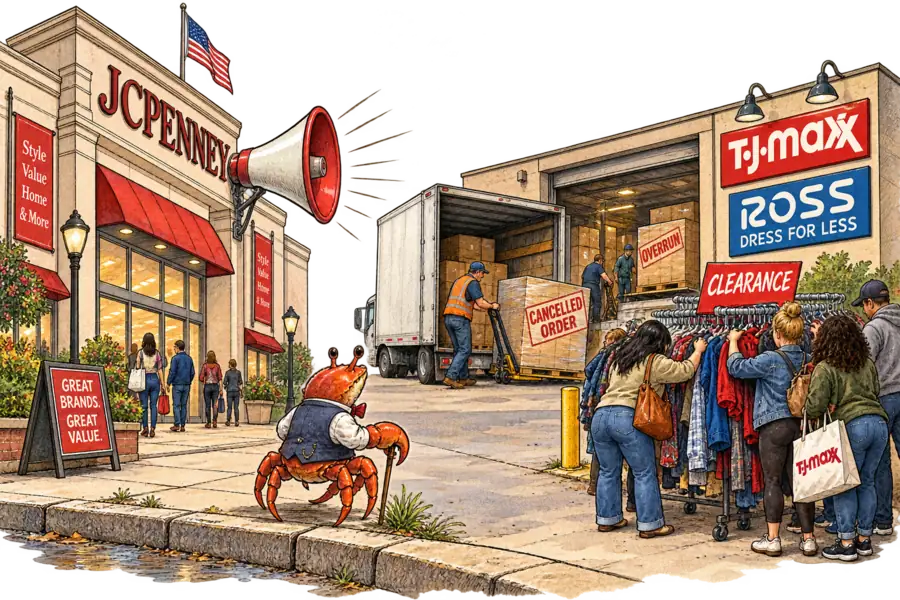
The advantage under attack sits upstream of the shop floor. TJX’s fiscal 2026 annual filing calls its method opportunistic buying: over 1,400 buying associates working from buying offices across the globe, sourcing from more than a hundred countries, taking cancelled orders, manufacturer overruns and other retailers’ closeouts as they surface. The assortment is assembled out of other companies’ mistakes. Shoppers call the result a treasure hunt for want of a plainer word for a rack nobody planned.
The method filed its report on Wednesday. TJX posted second-quarter net sales of $15.2 billion on comparable sales up 4%, held $7.9 billion of inventory against $7.4 billion a year earlier, and raised its full-year guidance. Marmaxx, its largest US chain, came in below plan at 1%; the guidance went up anyway. Ernie Herrman’s explanation was a remark about supply rather than demand: availability of branded merchandise “continues to be outstanding.” An off-price chief executive gets to report on what the company was able to buy.
A marketing brief can promise a better price; it cannot promise the accident that produced one.
JCPenney is moving the other way. First-quarter net sales fell 4.6% to $1.25 billion, the net loss narrowed to $65 million, and inventory came down 1%. Gross margin contracted anyway, on tariffs and heavier promotion. A chain buying to a seasonal plan defends margin by ordering less, which is prudent, and which also guarantees the racks hold nothing a shopper did not expect.
Ross ran the same three months. Comparable store sales rose 17% on sales of $6.0 billion, with customer traffic cited as the primary driver. Traffic is the number that matters, because those shoppers chose the trip. Nobody at Ross made a film about it.
The trade reading is that the campaign will not work because JCPenney lacks differentiation. eMarketer reached that verdict this week, and reached it by the wrong road. Differentiation is the symptom. What produces it is an open-to-buy held loose enough to take a deal at short notice, and JCPenney’s merchants do not hold one.
The trade-in runs 28 to 30 August: surrender a purchase you regret, take $15 off $50. That is thirty percent, offered to a shopper who learned years ago to find thirty percent without being asked to repent for it. The surrendered goods go to charity. Each of them reached an off-price rack because a buyer somewhere ordered too many, working to a plan.