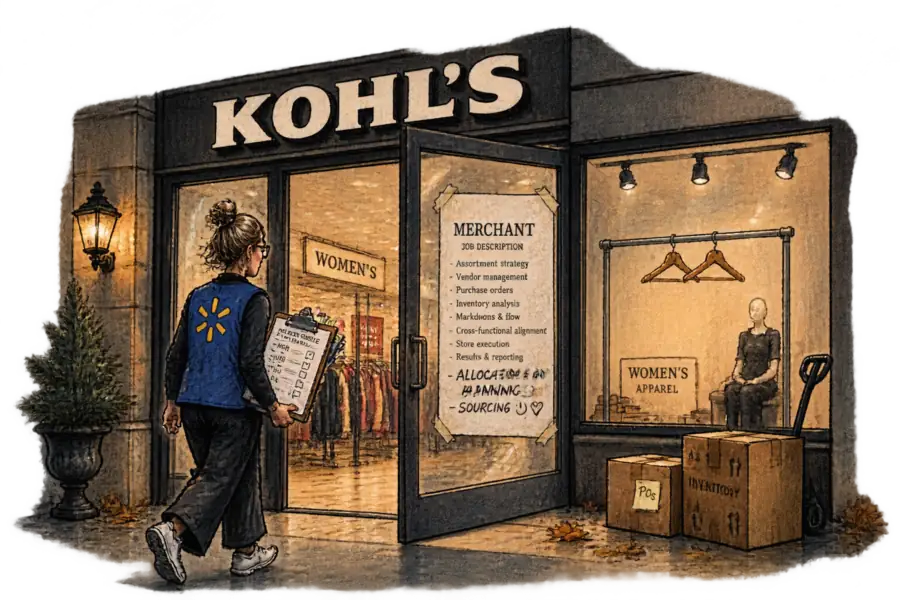
Kohl's Put Allocation in the Job, Then Hired Walmart's Merchant
Ryan Waymire arrives from Walmart on 28 September with allocation, planning and sourcing written into a chief merchant's brief that did not contain them in 2023. Kohl's womenswear sold out last quarter before it could be refilled, which is the problem the hire is for.
Sir John Crabstone
Kohl’s has decided that its apparel problem is arithmetic. Ryan M. Waymire, senior vice president of fashion at Walmart U.S., becomes chief merchandising officer on 28 September, with allocation, planning and sourcing written into the brief. The company has stopped hiring taste and started hiring logistics.
His predecessor’s brief was written for a different theory of the business. When Kohl’s named Nick Jones chief merchandising and digital officer in February 2023, the announcement listed four functions, and neither allocation nor sourcing was among them. Jones arrived at that job from the chief executive’s chair at Joules, a premium label — but before Joules came a decade as Chief Merchant for ASDA/Walmart UK, and before that, fifteen years at Marks & Spencer. He too had Walmart on the résumé; what changed was what Kohl’s asked him to do with it. In 2023 he was engaged to give the floor a point of view. Waymire has been engaged to give it a delivery date.
The résumé Kohl’s published names Walmart, Amazon, Target, Wayfair and FabFitFun. It is a record of moving volume through systems: apparel on a marketplace, a subscription box. None of it required an answer to why anyone should choose a department store. Kohl’s has read that as the qualification, which tells you what it thinks is broken.
Kohl’s is on its fourth chief executive in four years, and there is no merchandising strategy built to survive that turnover. An allocation rule, unlike a point of view, does not need replacing with the next one.
The quarter behind the hire is more instructive than the hire. Kohl’s turned over $3.3 billion in the thirteen weeks to 1 August, comparable sales down 0.9%, inventory 3% lighter than a year before. Marketplace volume, which that comparable-sales figure excludes, grew 88% in the same quarter. A chain carrying less on purpose has to be right about what it carries.
Choice count came down by the mid-teens, management said on the second-quarter call, while the depth behind each choice rose and receipts ran 7% higher. Store sales fell 2% as digital rose. Women’s proprietary brands sold through early, faster than the company could replenish them, and fall receipts had to be pulled forward to cover the back half. That is not a taste problem — it is a replenishment problem.
Kohl’s is no longer asking what its customer wants; it is asking where her size went.
The trade has read the appointment as pedigree. Proprietary brands grew 3% in the quarter, half the rate of the quarter before, as Retail Dive reported. UBS told clients that the moderation mattered, since own-label is what has been bringing shoppers back, and that the share lost to off-price may be underappreciated. Off-price, on that logic, wins on buying and placement — and Kohl’s has just hired for both.
Waymire leaves a business that grew Walmart U.S. comparable sales 2.6% on 1.5% more transactions in almost exactly the weeks Kohl’s slipped. Those visits come with the groceries. Kohl’s still has to be a reason to leave the house, and no allocation rule has ever written one.