JD.com's European Plan Now Starts at the Supplier, Not the Shopper
JD.com has placed a director of European direct sourcing in London to buy brands' stock outright for Chinese customers. The hire comes from the agency layer that a direct buying desk is designed to make unnecessary.
Sir John Crabstone
JD.com has put a director of European direct sourcing in London, buying fashion, sport, health and beauty for its 700 million annual active users in China. The operative word is direct. A platform that waits for brands to list negotiates commission; a platform that buys negotiates cost. JD did not announce which it had chosen. The new hire did, on LinkedIn.
JD’s own accounts settle what kind of company is doing the buying. Second-quarter product revenue reached RMB 267.1 billion against RMB 30.9 billion from marketplace and marketing. That is close to nine yuan of goods bought and resold for every yuan of rent collected from a seller. Commission is what JD takes when it cannot buy.
Direct sourcing is a plain arrangement. JD buys the goods outright and prices them itself. The brand keeps its wholesale margin and gives up every decision taken after the invoice.
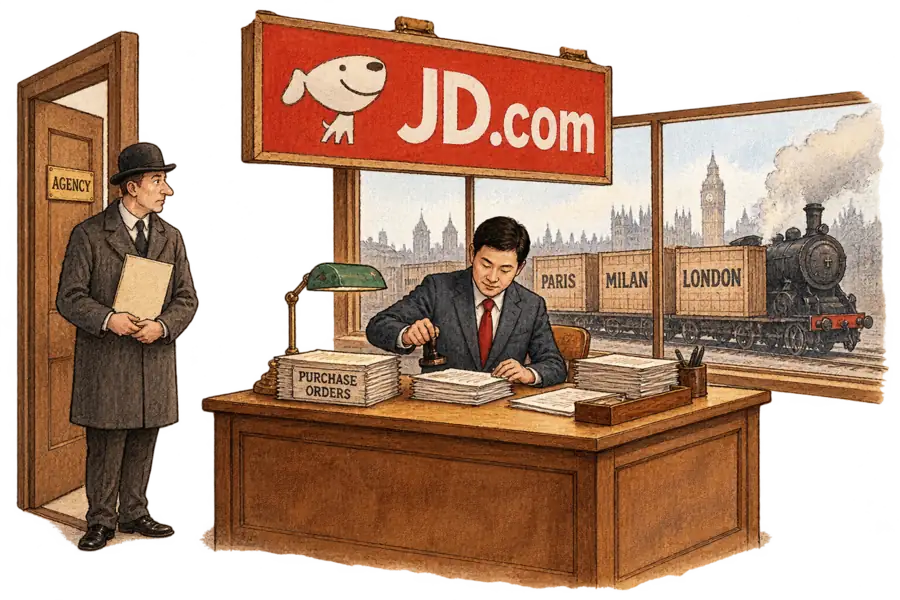
The building arrived two years before the buyer. In January 2024 JD Worldwide opened a self-operated direct procurement warehouse at Val-d’Oise outside Paris, stocked from more than a hundred European brands. Louis Zhang, who runs luxury and fashion there, called the plan “expanding our supply chain to the very locations where brands are based.” London is the purchase order Paris has been waiting for.
Zarina Kanji arrives from WPIC Marketing + Technologies, a five-star Tmall Partner as of Alibaba’s 2020 rating. WPIC runs Western brands’ Chinese storefronts on their behalf. The CV behind that includes five years in business development at Tmall Global and a buying career at House of Fraser and Ralph Lauren. A decade spent helping brands open their own shop in Asia, ending at the company that would rather own the stock.
The quickest way to learn what the middle costs is to hire someone who used to charge for it.
Retail Bulletin read the hire as a career move, setting it beside Joybuy, JD’s UK shop, as proof of European ambition, and quoting Kanji’s own description of the work: export growth. Export is a supplier’s word, not a shopper’s. Joybuy sells to Europeans; the London desk buys from them and ships east. Only one of those changes what a European brand can charge.
Joybuy is travelling away from ownership besides. It opened in March selling stock JD owned, and by June was preparing a curated marketplace for third-party sellers. JD is loosening its hold on the shelf where it sells to Europeans and tightening it where it buys from them.
For a European brand the offer is volume and a single negotiation instead of a distributor who must be persuaded, market by market. We noted this morning that Nike went to LVMH to buy back exactly the control JD is asking brands to sell. A brand that sells to JD names its price once. After that, JD names it.