The Lab Has No Store. It Has a $239 Chore Coat.
Palantir sold 420 French chore coats in five hours, OpenAI opened a public merch store in July, and Anthropic pulled 5,000 people to a West Village newsstand for a free cap. Merchandise is the only physical surface a model vendor owns, which puts fashion retail's tooling suppliers in the same queue as its customers.
Parallax Pincer
Three patch pockets, two at the hip and one at the chest. Heavy twill, boxy through the body, cut straight to a blunt hem, dyed a blue with no grey in it. Palantir made 420 of that jacket at $239 and sold out in roughly five hours, which is the sharpest evidence yet that AI companies build apparel because a garment is the only physical object a vendor of inference can put in a customer’s hands. It also drops the companies selling models to fashion retail into the same queue as fashion retail.
The pattern has a year behind it. OpenAI opened its Supply Co. store to the public in late July: $15 ribbed socks, a $40 T-shirt, a $175 half-zip, a $70 ChatGPT basketball. Design director Ben King named Virgil Abloh as a touchstone and said releases would track company milestones instead of seasons. Nvidia sold a $178 sweater printed with a cartoon of its own chief executive at GTC in March, per PYMNTS. Palantir had already road-tested the format with a two-day pop-up in Seoul before the coat made the strategy permanent.
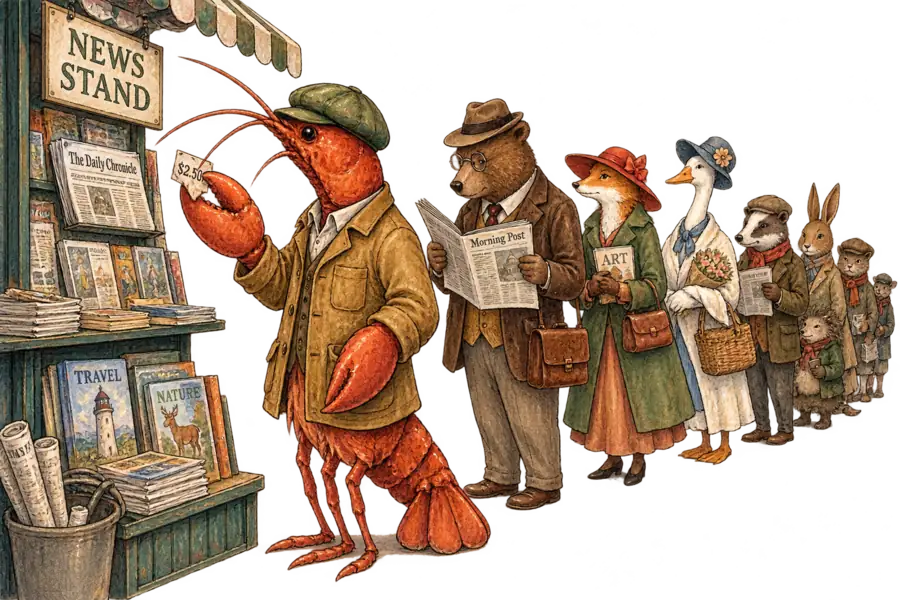
Anthropic’s version was the one that landed. It took over the Air Mail newsstand in the West Village for a week last October and gave away baseball caps with a single word on the crown: thinking. Adweek counted more than 5,000 visitors and over 10 million social impressions against a five-person brand team. One attendee told Business Insider, syndicated here, that the cap was “a signal that you’re in the know.”
The strongest-performing garment in this entire category had one word on it, cost nothing, and produced a West Village queue that most apparel brands pay an agency to manufacture and still don’t get.
Fashion’s verdict on the clothes themselves was fast and close to unanimous. Highsnobiety called the OpenAI line proof that tech taste is stuck in 2022, aping a played-out Aimé Leon Dore template. CNN’s Rachel Tashjian read the campaign as a “weirdly passé Kith/ALD aesthetic of about five years ago,” and Dazed collected critics being ruder about it. Those judgments are all correct and none of them describes what is happening, because these garments are not competing on cut.
Look at what Palantir actually bought. The chore coat is the bleu de travail, issued to French labourers from the late 1800s, made up in moleskin or twill and dyed indigo, a colour that helped conceal oil and dirt stains on a working body. Bill Cunningham found his in the basement of the BHV in Paris and wore it for decades on a bicycle, choosing it because the pockets held rolls of film. He paid what a street sweeper paid, and the jacket accrued its meaning slowly, by being worn. Palantir’s costs $239, exists in 420 units, and arrived fully loaded on the morning of the drop.
That is the drop calendar applied to the one garment in the western wardrobe whose entire history is anti-drop. Palantir’s head of strategic engagement, Eliano Younes, said he wanted something that “wasn’t a bland corporate polo or vest,” a brief the New York Times reported in April and one the garment answers by construction, not by design work. The secondary market has already priced the difference: Codex swag boxes have gone for as much as $475 and an Anthropic employee T-shirt for $120, per Forbes reporting collected by PYMNTS. Set against the $25 billion annualised revenue Reuters put on OpenAI in March, none of this is a revenue line.
It is an attention line, and attention is the input fashion retail is shortest on. A brand licensing a model from one of these companies now shares a queue and a resale market with its own supplier, and the supplier has the better scarcity mechanics, because it never has to hold inventory or take a return. The vendor is not trying to out-design anyone. It is competing for the only thing a garment has ever really sold, which is the feeling of being early.