The Label Went to a Certifier. 'Eco-Friendly' Stayed in the Product Feed.
From Sunday, 'eco-friendly' is unlawful in the EU unless the same page explains it or an official ecolabel backs it. The word lives in product copy that software now drafts by the thousand, so the safeguard belongs in the product data, before anything is published.
Sir John Crabstone
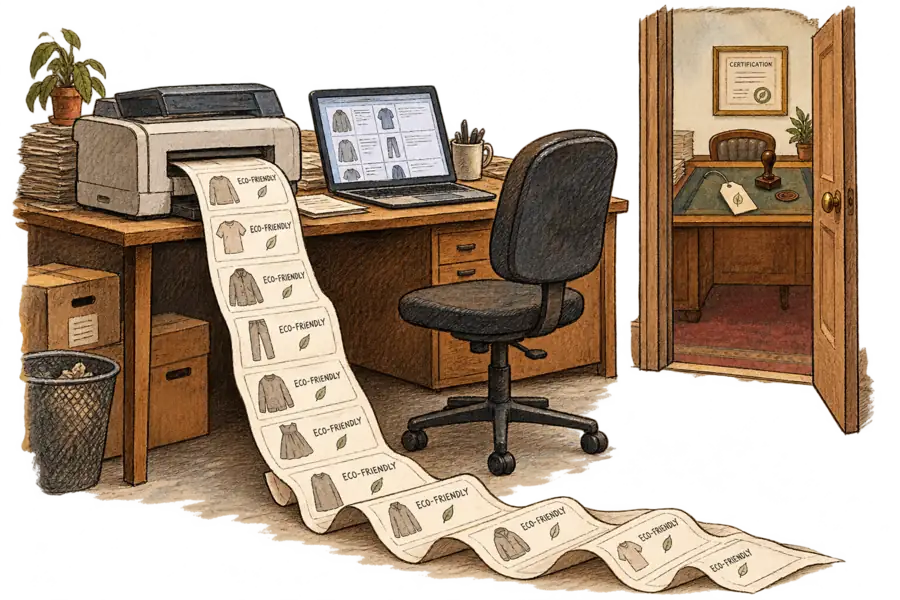
From Sunday, “eco-friendly” is unlawful in the European Union unless the same page explains it or an official ecolabel stands behind it. The word lives in product descriptions, which retailers and marketplace sellers now generate by the thousand. Few are read line by line by anyone who must answer for them. Our August piece followed the label to the certifiers who now vouch for it. The adjective stayed in the product feed, and nobody can fine the model that wrote it.
The rule is narrower than its reputation. Directive (EU) 2024/825 blacklists generic claims such as “eco-friendly” unless the trader can show “recognised excellent environmental performance” — for clothing, in practice, that has so far meant an official ecolabel, since no other route exists yet. A claim stops being generic once its specification sits “in clear and prominent terms on the same medium”, and the recitals count the “online selling interface” as one. The law, in effect, measures the distance between an adjective and its explanation.
Writing in Drapers on Thursday, Bird & Bird partner Constantin Eikel puts that distance at zero: the explanation belongs on the same webpage, “not a click away”. His remedy is to audit product pages, old ones included, and to train marketing and buying teams. It is sound advice for a house that still employs its copywriters. Increasingly the copy is written by a model, and the model has already been trained, on a web written before the ban.
The software now writes faster than anyone reads. Amazon says independent sellers in its store created more than 12 million “sales-ready” listings with generative AI last year. A Californian seller of personalised gifts, quoted in the same release, explained the appeal: “When you have over a thousand listings, saving a couple minutes per listing means what would take weeks to do manually was completed in hours.” A clothing catalogue runs on the same arithmetic, and no one checks an adjective against a certificate in seconds.
A listing written by a person had at least one reader, its author; a generated listing need not have any.
Scanners built for the deadline are already on sale, and they come cheap. EcoClaim checks a shop’s pages against 82 banned terms in about 60 seconds and offers AI-written rewrites to paste in; its starter pack costs €39.99. A crawler reads what shoppers can see. It does not ask what evidence stands behind the words it flags.
The better control sits before publication, in the product data. Verena Jasper, who heads corporate responsibility at Bonprix, told TextilWirtschaft this month that the retailer’s material information now goes a level deeper, down to which components a certification covers. Little had to be removed, she said, though the website update is still under way, and she is not yet certain the rule reaches listings published before the ban. Give each claim a field for its proof, and an empty field can block the adjective before any lawyer sees it.
The product feed is where the explanation falls away. A feed splits each product into fields for separate sales channels, and in most shopping feeds the ad a buyer actually sees shows the title without the description. The Commission’s questions and answers on the directive, last updated in May, reaffirm a line from 2021: “If there is no space to specify the environmental claim, then the claim should generally not be made.” The evidence travels with the adjective, or the adjective does not travel.
Bird & Bird offers clients an AI scanner of its own, with Eikel as the contact. Its redrafting feature carries a warning: “All proposed wording should therefore be reviewed and validated before publication.” The firm offering the machine wants a reader all the same. From Sunday, somebody will read these listings line by line; the retailer’s one remaining choice is whether that somebody works for it.