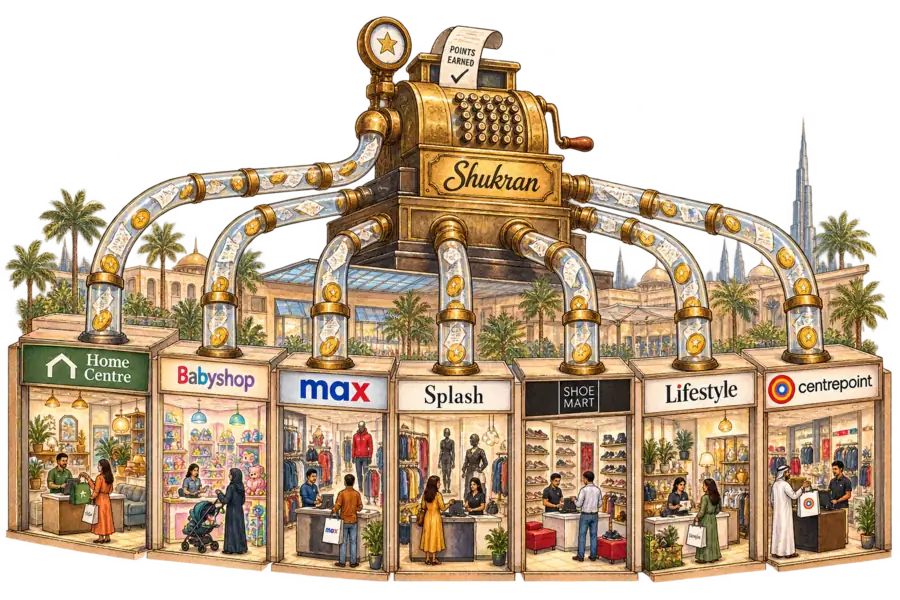
Landmark Split the Shopfront and Kept the Till
Landmark Group replaced its group portal with seven separate brand storefronts and kept one basket, one checkout and one loyalty ledger behind them. Nine years on, the split has held, and the Gulf's best-known fashion pure-play changed hands for a premium of Dh127m on everything its owner had put in.
Sir John Crabstone
Landmark Group deleted its own front page nearly ten years ago and lost nothing that mattered. On 24 November 2016 the Dubai conglomerate retired LandmarkShops.com for seven separate brand sites: Home Centre, Babyshop, Max, Splash, Shoe Mart, Lifestyle and Centrepoint, as RetailME reported. Everywhere else the direction of travel was toward one window. Landmark took its own name off the door and left the brands on it. No group its size had tried the reverse.
The split stopped at the shop window. Behind the seven sites sat one universal basket and one checkout, with accounts carried over whole, down to saved cards and Shukran preferences. Sixty-one per cent of the retired portal’s shoppers were Shukran members, a ledger no retailer hands back for seven prettier addresses. Landmark had not dismantled the aggregation; it had stopped advertising it.
Landmark gave the shopper seven brands and kept one shopper for itself.
The arrangement has outlasted almost everything announced beside it. The split bought something more useful than seven storefronts. It bought the join: one identity carrying seven brands’ worth of behaviour, which is what personalisation engines and retail media desks now bid for. Every basket built inside those seven sites still teaches Shukran what one shopper buys across all of them, the exact signal retailers now pay dearly to construct from scratch.
The case against Landmark is the ordinary one. Marketing spend, catalogue photography, checkout engineering — seven of everything instead of one. Aggregation buys traffic and spreads fixed costs thin; a brand site opens each morning with neither. It is a good argument. It was tested next door, at length and at cost.
Emaar Malls assembled Namshi in two purchases from 2017 to 2019, then sold the Gulf’s best-known fashion pure-play to Noon in a 2022 deal worth Dh1.23bn, a premium of Dh127m on everything it had invested. Emaar called it portfolio discipline. The rest of that cheque was its own money coming back. Landmark spent those years opening shops.
A newer market produced the same reflex. Styli is a Landmark-owned label rather than a group storefront, launched in Riyadh and marking its first anniversary in late 2020 with roughly 250,000 shoppers and nearly 500,000 transactions, Campaign Middle East reported. Around seven in ten of those customers were under 25. Given a market it did not yet own, the group built another name.
The money still goes behind the sites. Landmark fitted its Kuwait fulfilment centre with upgraded robotics last November, feeding localised brand platforms for Centrepoint, Max Fashion and Home Centre with same-day delivery and click-and-collect, as TechAfrica News reported. A robot does not care whose logo is on the parcel. The shopper does.
Renuka Jagtiani, the group’s chairperson, counted more than 2,500 outlets across eleven countries and revenue above $7.5bn, in an interview reported by Emirates 24|7. Another 115 shops are due inside the year. The stores are where a Gulf shopper learns to trust a name; the seven websites only have to bank it. Namshi never had that luxury.