Lands' End Lost the Mailing List. It Rented a Tailgate.
Lands' End mailed 200 million catalogues in fiscal 1996 against a house list of 22.4 million names. This autumn it is running a three-stop game-day tour with Graduate by Hilton, because nothing it has built since replaces the addresses.
Sir John Crabstone
Lands’ End mailed roughly 200 million catalogues in fiscal 1996. The house list behind them held 22.4 million names, 8.4 million of whom had bought something in the previous three years. This autumn the company is pouring free coffee in three college towns. The list has no successor, so a crowd is standing in.
Sears agreed to pay $1.9 billion in cash for the business in 2002. The parkas were not the expensive part. What changed hands was four decades of American addresses with a purchase history attached to each.
At Lands’ End the catalogue was never advertising. It was the shop. A Kurt Salmon study reported by Retail Dive found the company halted catalogue production in 2000 to save money and lost $100 million in sales. When the book came back, the website asked buyers whether they had seen it first; three-quarters said yes.
Every year the catalogue costs more to send. Lands’ End’s fiscal 2024 annual report notes rising postage and printing costs and describes the company as “optimizing our catalog productivity” — the company’s own word for a retreat. It also warns that customers who relied on the direct mail catalogue may not respond as favourably to whatever replaces it. That warning is the strategy, filed as a risk factor.
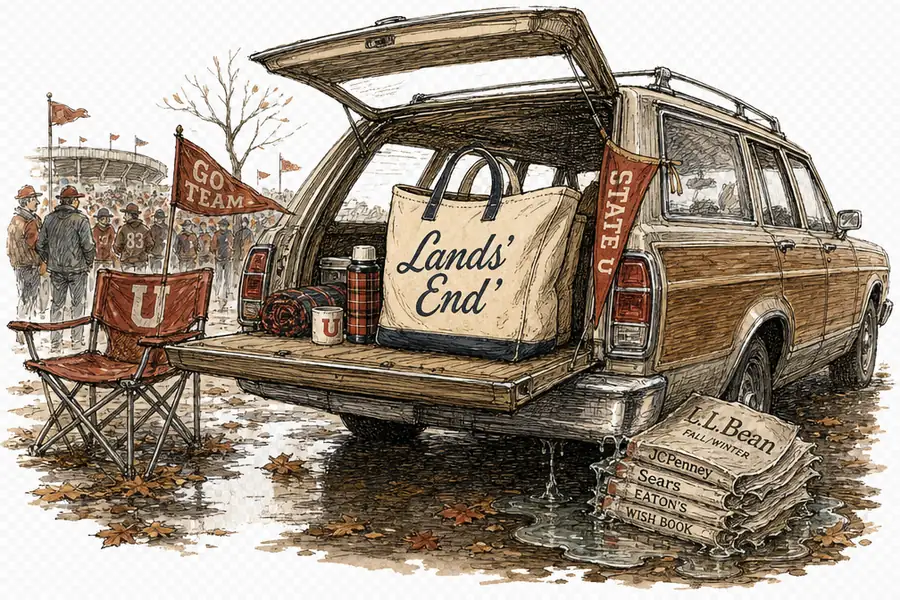
What replaces it, for now, is a Tote Tailgate Tour: game-day stops in Bloomington, Ann Arbor and Oxford, staged inside Graduate by Hilton coffee shops, the same three towns where the hotel chain already operates properties. The takeover has its own name, a run of Poindexter Coffee Shop pop-ups, but the tote is doing the recruiting: cut clear, to satisfy stadium bag policy. Sarah Sylvester, six months into the first CMO post the company has filled in a decade, likes game day for being multi-generational.
Lands’ End did not lose its customers; it lost their addresses.
Michigan’s stadium alone seats more than 107,000; Ole Miss and Indiana add tens of thousands more between them. One Saturday in each town puts the brand in front of a combined crowd approaching a quarter million. Nearly all of them will walk away without leaving a name.
The second quarter suggests the arithmetic is understood. Revenue rose 2.7 percent and gross margin improved 320 basis points, yet adjusted EBITDA fell to $11.3 million from $15.1 million as selling costs rose, partly on digital marketing aimed at new customers and partly on a new warehouse system still working out its faults. The company is buying names again, and paying retail for them. Rebuilding a list from zero has never been cheap.
Charlie Cole, chief executive since July, wants an AI engine that tailors what each shopper sees. New-to-file customer counts grew double digits last quarter, he told analysts, driven by totes and swim. Personalisation refines a file; it cannot lengthen one. Two hundred million catalogues once reached more people before breakfast than three stadiums will all autumn. Lands’ End is choosing to meet them by hand instead.