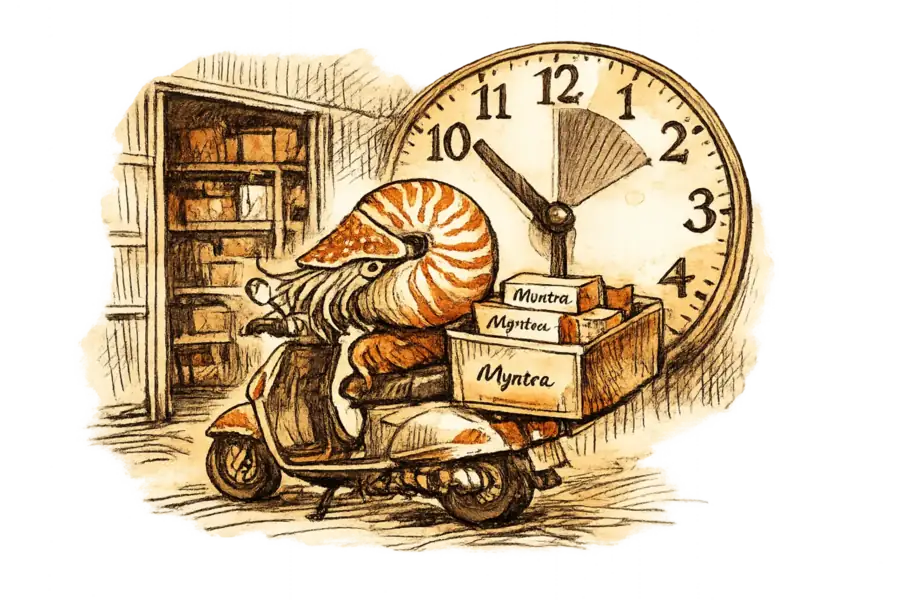
30-Minute Apparel Delivery Turns Clothing Into a Convenience Category
Myntra's M-Now quick-delivery service captured 10% of orders in active markets within a year, stocking 100,000 styles across 87 dark stores for 30-minute fulfillment. The speed compresses the apparel purchase from a considered decision into an impulse, threatening mid-market brands whose pricing power depends on deliberation.
Neritus Vale
Myntra’s quick-delivery service M-Now captured 10% of orders in every city where it operates within its first year, backed by 87 dark stores stocking over 100,000 styles across 10 Indian cities. That figure measures a shift in purchase mode, not logistics. When clothing arrives in 30 minutes, the consideration window that premium and mid-market brands rely on collapses to a single scroll.
M-Now launched in select Bengaluru pin codes in November 2024 and now covers 940 pin codes across metros and tier-2 markets including Patna, Jaipur, Lucknow, and Ahmedabad. The fastest recorded delivery took 10 minutes in Bengaluru. In its first year, the service drew 35 million unique visitors and reached 20% customer penetration in active locations. Myntra is not alone: Flipkart Minutes reported 16X order growth in the second half of 2025 and had targeted 1,000 dark stores by March 2026. NEWME, a Gen Z fashion startup, raised $18 million in a Series A and has since launched 60-minute apparel delivery in Delhi and Bengaluru. Slikk operates a 30-minute model in Bengaluru on a $10 million Series A.
India’s quick commerce sector has scaled into a $10 billion-plus GMV market with over 30 million monthly users, and the growth is migrating away from groceries. Non-grocery categories grew roughly 1.6 times faster than grocery in the most recent Redseer tracking period. Fashion sits at the front of that expansion. Blinkit, which operates over 2,000 dark stores across 153 cities, now stocks apparel from Fabindia, Jockey, and US Polo Association and is testing 10-minute returns for clothing and footwear. When a grocery platform invests in reverse logistics for jeans, the category has moved past experiment.
The geographic push reveals where the next volume sits. Over 70% of new customers who joined Myntra in 2025 came from non-metro markets. Myntra already ships to 98% of India’s serviceable pin codes through standard delivery; M-Now layers 30-minute fulfillment on top across its dark store network. The February 2026 expansion into Patna, Jaipur, Lucknow, and Ahmedabad targets shoppers whose alternative is a local store or a multi-day wait. For a shopper in Lucknow, 30-minute delivery does not compress the timeline. It removes the comparison step entirely.
The compression changes which brands win. During M-Now’s first year, sports footwear, premium beauty, and last-minute gifting were the highest-growth categories, each defined by urgency rather than consideration. A 30-minute delivery window selects for recognition at scroll speed, not for narrative built over a days-long consideration period. Slikk’s average order value of ₹1,800 sits well below the mid-premium price band where Myntra has built its traditional margin. That gap is structural: when a purchase decision takes seconds, the buyer defaults to the cheapest recognizable name. Brands in the ₹1,500-to-₹4,000 range are the most exposed, because their entire margin depends on the customer pausing long enough to perceive quality differentiation.
The dark store, not the brand page, is where the sale now starts.
The counter-argument is that returns will collapse the economics before the model scales. Online apparel in India carries return rates of 25–40%, driven by sizing inconsistency and the absence of standardized fit data across Indian manufacturers. Quick commerce platforms initially offered no return policy for fashion, which capped adoption. This is plausible, but only if the return infrastructure stays frozen. Blinkit is already piloting 10-minute returns and exchanges for apparel and footwear. If reverse logistics matches the speed of forward delivery, the return problem shifts from dealbreaker to feature — try-before-you-commit at convenience-store pace.
If M-Now’s 10% order share in active cities holds as the network scales past 10 markets, Myntra will have demonstrated that apparel can sustain the unit economics of hyper-speed fulfillment. India’s fashion e-commerce market is valued at $21.6 billion and projected to reach $98 billion by 2032. Even a single-digit percentage shift of that volume into 30-minute channels reshapes how brands allocate inventory, set prices, and justify premium positioning. Myntra CEO Nandita Sinha called M-Now “a key growth engine” drawing in new customers. What it is also drawing in is a purchase mode that does not wait for a brand to explain itself. The brands that survive this compression will be the ones whose value registers before the delivery rider has left the dark store.