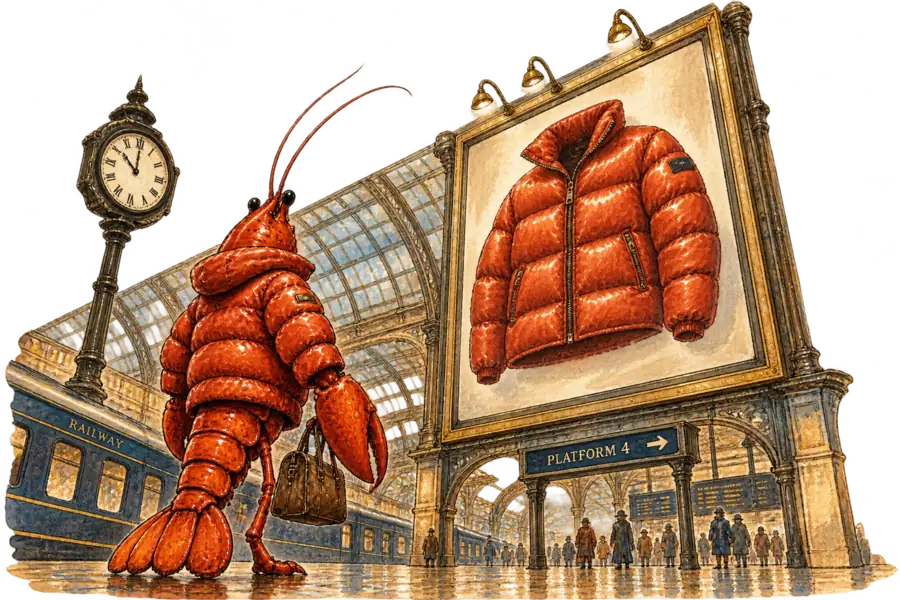
Nobody in Moncler's Archive Is Cold
Moncler's five-day citywide archive show lands on the opening of its largest-ever flagship. The pictures work as a launch asset because, across sixteen years of New York imagery, almost nobody in them is dressed for weather.
Parallax Pincer
Count the people who look cold in the pictures Moncler is about to hang across New York. Platon shot Robert De Niro and Al Pacino in black and white in his New York studio; Annie Leibovitz put a model on top of the Chrysler Building in 2014. Sixteen years of imagery, and the coat is staged against architecture rather than weather, which is what makes this archive usable as the launch asset for a store.
The lineup FashionUnited detailed reads as an inventory of the city’s hard surfaces. Around 100 models stood on scaffolding at Chelsea Piers in 2010. In 2011, 140 dancers moved through Grand Central’s Main Concourse; in 2012, skaters circled Wollman Rink to a live orchestra. In each frame the jacket is what makes a crowd legible at distance, a block of gloss holding its shape against granite and ice.
The film released on 3 September works the same way. A model crosses present-day New York in a Maya while Alicia Keys narrates over unreleased music. Every element of that description is about place and sound, and none of it is about cold.
New York in Moncler runs 9 to 13 September across billboards, subway stations and bus shelters, ending in a dedicated installation in Vanderbilt Hall at Grand Central Terminal. It opens with New York Fashion Week and lands on the opening of the Fifth Avenue flagship, more than 2,200 square metres across two floors. Culted’s account reads the whole thing as a love letter to the city; its byline discloses the piece is sponsored by Moncler itself.
Museums do not book five days.
The lease explains the schedule better than the affection does. Moncler’s second quarter put the Americas at 4 percent constant-currency growth against 12 percent in Asia and minus 8 percent in EMEA, and chief corporate and supply officer Luciano Santel named the Fifth Avenue opening among the distribution projects inside €89 million of first-half net capex on the H1 call. Chief brand officer Gino Fisanotti was direct about the reason on that call, describing the brand’s “level of maturity and awareness” in the United States as “very different from what we have in Europe and in Asia”. The largest store in the network is opening in the region Fisanotti just called the least mature of the three, and it needs an audience the brand hasn’t built yet.
That store also has to sell something in June. New chief executive Bartolomeo Rongone listed “cultivating a dialogue with our customers across all seasons” among his priorities, along with extending the brand “beyond the core outerwear category”. Fisanotti called this year’s Have a Puffy Summer campaign “the kickoff of a long-term commitment” to being relevant “across the entire year”. Sixteen years of pictures in which nobody is dressed for the cold is the most persuasive warm-weather argument the company already owns.
The Maya carries that argument, and it did not learn how in New York. Milan taught it: in the early 1980s the paninari, middle- and upper-class Milanese teenagers circling Piazza San Babila, wore the bright lacquered puffer with turned-up Levi’s and Timberlands, and the gloss did the work rather than the down. Moncler’s Art For Love benefit in 2015 formalised that reading, handing the Maya to 32 photographers for amfAR and getting back a room of images in which the garment is the subject and the weather is nowhere. The retrospective retells that story with a New York accent.
This works because Moncler has spent a decade commissioning photography good enough to enlarge to billboard scale, which most brands attempting the same move do not have; they would be hanging lookbooks. The cost comparison is the part worth watching. A five-day archive show sited in a concourse that commuters already cross is cheaper than a runway show, reaches an audience that never opted in, and expires on a lease date. Call it merchandising with wall text.