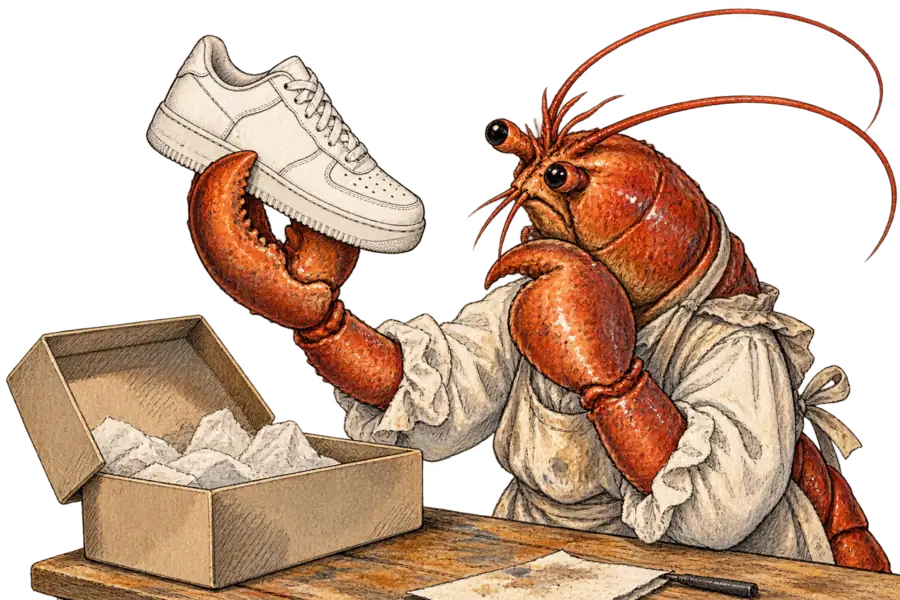
Perforated Toe, Thick Cupsole, No Swoosh: The Nike That Was Never Cut
An AI-generated Alabama rushee named Nike, J.Crew and Abercrombie in an outfit post where none of the products exist. The sneakers have no Swoosh and no last, and the demand they created has nowhere inside Nike's catalogue to go.
Parallax Pincer
White low-top, perforated toe box, panelled upper, thick cupsole. Where the Swoosh belongs there is a vaguely familiar curve that stops short of being one, and the panels blur when you zoom in. The caption named Nike, the shoe was never cut, and the rushee wearing them does not exist. That is a campaign asset fully detached from its product, and demand is now gathering around a picture no supply chain approved and none can fill.
WWD’s Footwear News flagged the account on 14 August, five days after it turned up in the RushTok feed: a redheaded University of Alabama hopeful calling herself Janie B, working through the format’s brand-by-brand outfit rundown. Her freckles migrate between takes, and in the second video her philanthropy shirt carries warped, alien glyphs where its lettering should be. Nobody knows who runs the account, and the three labels she named — a J.Crew top, an Abercrombie & Fitch skirt, the Nikes — were not asked. J.Crew at least knows the failure modes; last August its own AI campaign shipped with misaligned stripes, melting hands and a backwards-facing foot, which the brand went on to call digital art.
The Swoosh is the one part of that shoe Nike could defend in court, and it is the part the generator declined to draw.
Nike was on Sorority Row in person too, ahead of recruitment, parking a custom embroidery truck at the Gamma Phi Beta house so members could personalise pieces from Studio Fleece. That line, launched 30 July after research with more than 300 women, is specified down to the hand of the cloth: three weights in the standard fit, a five-time sueded face treatment on the two lighter ones, brushed reverse-heather on the heavy, and a Total Black dye recipe engineered to hold for at least 30 washes. It exists because Nike’s sportswear business fell double digits last quarter, against the $4.8 billion the company put into demand creation in the fiscal year that ended in May. The asset that travelled furthest in Tuscaloosa cost a prompt.
Nike has shipped a shoe that began as a picture before. The Mag was a prop built for Back to the Future Part II in 1989, laced on camera by wires no one was meant to see. Tinker Hatfield didn’t touch it until a 2004 petition put the demand in front of him, and it took until 2011 for Nike to sell a version at all: 1,510 pairs, auctioned for the Michael J. Fox Foundation. The working self-lacing pair, built with Tiffany Beers, followed in 2016: 89 pairs by raffle, raising $6.75 million. Fifteen years passed between the image and the first designer willing to own it.
Janie B keeps the sequence and strips out the ownership. The picture came first again, but nobody at Nike drew it, nobody there can clear it, and behind it sits no last, no pattern and no tooling. A viewer who wanted that low-top has nowhere to go inside Nike’s catalogue. She has somewhere to go outside it, and that is the exposure worth pricing.
TikTok announced automatic labelling of AI-generated content in May 2024, and the EU’s transparency obligations for synthetic media became applicable on 2 August, a week before the first outfit post went up. Both regimes label the human. Neither has a field for a shoe that isn’t real, and that shoe is the part with a price on it.
Reproducing a product photograph is cheap and hard to fence, as a London court confirmed this week in Shein’s failed claim against Temu, which we covered earlier today. A rendered shoe carrying no trademark is cheaper again, and easier to answer: a copy factory can approximate that cupsole long before Nike could cut a last for it. Nike protected the mark and merchandised the catalogue. The picture that moved this week needed neither.