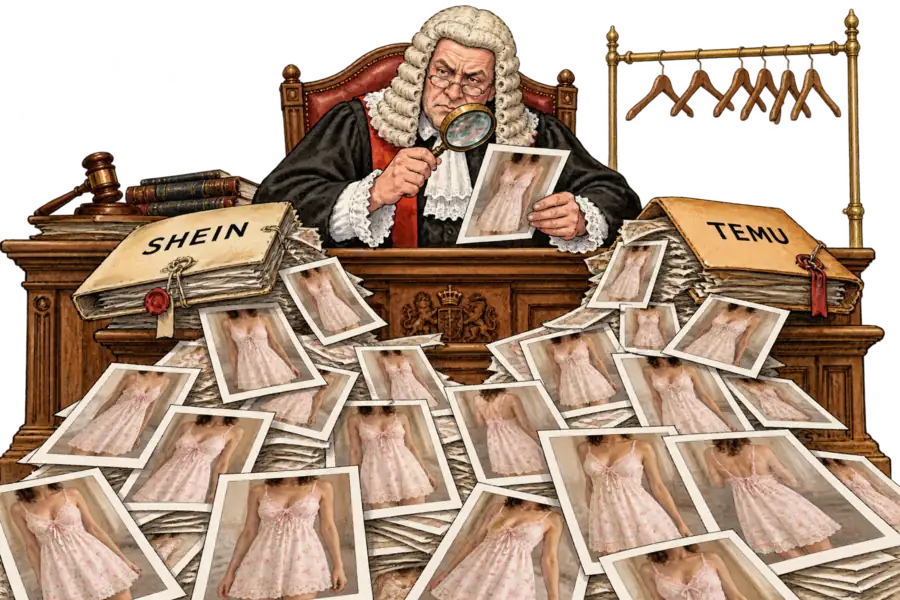
Shein Sued for the Pictures Because It Could Not Sue for the Clothes
Shein's London copyright claim against Temu failed across 2,559 product listings, and no garment design was ever in the case. The judgment shows the only asset fast fashion could make exclusive was the photograph, and not even that reliably.
Sir John Crabstone
Shein took Temu to London’s High Court over photographs of clothes rather than over the clothes. The claim Mrs Justice Bacon dismissed on 13 August covered 2,559 product listings, and no garment design was in it at all. Fast fashion moves faster than design protection can be registered or enforced. The photograph was the only part of the page Shein could plausibly hold as property. The court has now found it could not reliably hold that either.
Temu’s counsel framed the case correctly when it opened in May: this was an attempt to use copyright as a competition weapon, not a defence of anyone’s photographic craft. Shein’s own case ran on the same premise, in reverse — copying the images let Temu publish finished product pages without paying to make them. Both parties treated the photograph as a cost. They disagreed only about whose.
Shein had come to court alleging infringement “on an industrial scale”, as FashionUnited reported. It left with nothing. Temu prevailed as a platform rather than as a publisher. The judge found it had not authorised the merchants who uploaded the images, and that the hosting defence shielding intermediaries was open to it. Temu had not selected, edited, endorsed or promoted the listings. Shein lost one step before anyone weighed a picture.
The more instructive failure came from Shein’s own side, and earlier. Its June 2023 letter before action appended a schedule of 8,036 Temu URLs. Of the 2,559 listings eventually pleaded, 274 rested on photographs taken by suppliers or agencies, and title to most of those never survived to trial. At the date of that letter, the judgment records, Shein accepts it did not own the copyright in any of the employee photographs. The Guangzhou entity whose staff had taken them assigned the rights weeks later.
Eight thousand takedown demands went out on the strength of pictures the claimant had not yet acquired.
The trial sample shrank to match. Twenty listings were selected; fifteen fell away beforehand on defects of title. The judge found Shein had not verified the chain of title at all, taking warranties from suppliers instead. Of the sample, only one supplier photograph reached judgment on the merits. Shein won that title dispute and lost the claim anyway, because the supplier’s own principal had consented to the photo appearing on his cousin’s Temu store. Temu’s counterclaim stands: Shein is liable for listings pulled on images that were never its own, with damages to be assessed at a later trial.
Shein had already dropped its central allegation, that Temu itself copied the images, once it became clear Temu’s servers sit outside the UK. In law the copying happened where the court could not reach. Shein’s own statement afterwards named the location: “the servers supporting its UK website happen to sit in Ireland”, as just-style reported. Where exactly matters less than the principle. A right that travels with a rack of machines was never much of a right.
Most of the trade coverage has filed this as a lawsuit about photographs, which is how Drapers framed it, and that is correct as far as it goes. It is also a valuation. Shein spent three years establishing exclusivity over studio photography.
Product imagery stopped being scarce some time ago. The generators work; what they still want is catalogue data, not craft. Shein was defending the studio in the year the studio stopped being the expensive part of the page. The next fight of this kind will be over images no human took, where the ownership question is harder rather than easier.
Temu’s counterclaim says the real lock was on the factories, through exclusive supplier agreements, and that claim is still live. It names the asset Shein never had to photograph.