Pinterest's 14,000 GPUs Serve a User Worth 23 Cents
Pinterest expanded its Nvidia partnership on Monday — part of a five-year deal that has grown into a fleet of 14,000 GPUs — and, three days later, launched the ad format that sells the visual search they power. The order matters: 534 million of its 640 million users sit outside North America, where one of them returns as little as 23 cents a quarter.
Parallax Pincer
Tap a Pin of a bouclé armchair and a paying brand now sits inside the closeup, beside the object you were already looking at. Pinterest named that placement Visual Search Ads on 17 September, three days after expanding its Nvidia partnership — a five-year relationship that has grown into a fleet of 14,000 Nvidia GPUs, the silicon that makes the lookup behind the new ad format cheap enough to sell. The fleet came first and the invoice came second, because a fixed cluster serving 640 million people only clears its cost if the 534 million outside North America can be billed.
The arithmetic is in the second-quarter filing. In the US and Canada, 106 million monthly users returned $8.30 each; in Europe, 157 million returned $1.35; across the rest of the world, 377 million returned 23 cents. Those 377 million send the same image queries and draw the same inference as the users worth thirty-six times more. Pinterest’s fastest-growing region is also its cheapest, and the GPUs do not know the difference.
What the Nvidia stack changed is where the picture gets read. Pinterest now encodes an image once into a visual embedding and serves that stored representation rather than reprocessing the raw file on every request. Nvidia’s own case study puts the resulting AI transaction cost at under 8% of the previous figure, with time to first token up to 369 times faster. A drop that steep buys something other than speed. It buys permission to run visual lookup in a market where a user returns 23 cents a quarter.
Coverage of the deal ran on the speed multiples, which are the least interesting numbers in it.
The distribution layer was already in place. In late June Pinterest shipped an international shopping suite: multi-country catalogues that let one product feed serve several markets, an AI localisation tool that rewrites titles and descriptions into local languages and converts prices into local currency, a Markets dashboard, and multi-currency campaigns running through Performance+. Retail Week filed it under Technology. It reads better as billing plumbing for a compute fleet whose expansion had not been announced yet.
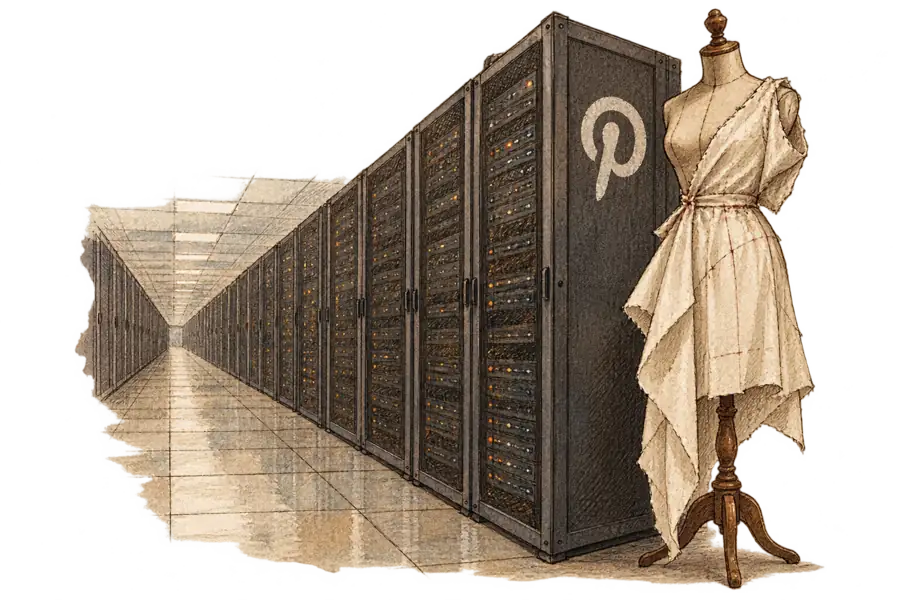
Paris ran a version of this arrangement in the 1950s. Buyers from Macy’s and I.Magnin came for muslin toiles and paper patterns, and the resulting dress was manufactured for the American market and advertised as a line-for-line copy. The master stayed in Paris. What travelled was a representation cheap enough to reproduce anywhere.
A visual embedding is that toile with the sewing taken out: computed once, reproduced in any market, rented by the impression. Ninety-six per cent of Pinterest searches name no brand at all. Chief business officer Lee Brown told the advertiser summit, in remarks reported by Modern Retail, that this is the opening rather than the problem. People arrive before the decision, he said, and “they don’t even know how to describe what they want, but they know it when they see it.”
We read Pinterest’s luxury pitch in May as a confession that the buyer has no question. The question now has a reserve price. In the same report, VP of go-to-market Chloe Wix says the format needs “no net new creative,” which is the detail carrying the strategy: a merchant already in the catalogue goes live across markets without commissioning one new image. Spend once on the fleet; collect 377 million times.