Primark Entered Mexico Without Signing a Lease
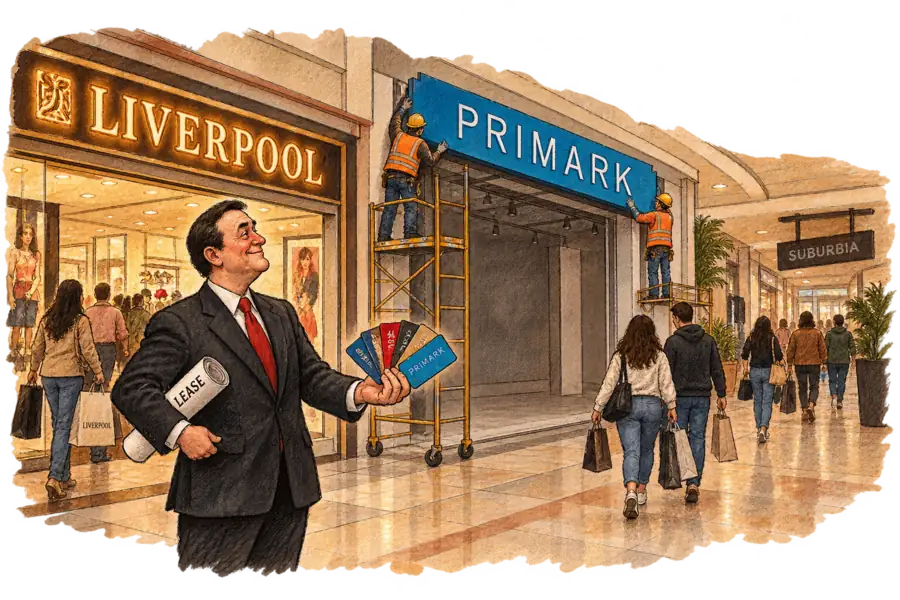
Primark's Latin American debut is a franchise: El Puerto de Liverpool supplies the buildings, the operation and the credit line, and Primark supplies the label. Liverpool's property and credit arms grew 8.6% and 9.9% last quarter while its retail arm managed 0.4%.
Sir John Crabstone
Primark will open its first Latin American stores without buying a metre of Mexico. El Puerto de Liverpool told the Mexican stock exchange on 10 September that it will operate the Irish chain under franchise, a structure it has used only in the Middle East. Primark supplies the brand and the garments. Everything else — the floor, the freight, the credit — belongs to Liverpool.
Those are the expensive parts. The group runs 321 stores under its two banners, 173 boutiques and 30 shopping centres, and 8.8 million cardholders now settle 54.2% of its sales on credit it issues itself. That credit is about to cost more: Liverpool is lifting fees and interest rates on those cards around the same date as this filing. A franchisee with a credit book can finance the basket as well as fill it. Primark has found a landlord who lends to the shopper.
Liverpool’s last quarter shows which half of the business is working. Commercial revenue grew 0.4% in the three months to June. The property arm grew 8.6% and the financial arm 9.9%, while Suburbia, the group’s own value banner, gave up 6.4% on a same-store basis. Selling clothes is the slowest thing Liverpool does. It has now agreed to do more of it for somebody else.
Traffic is Liverpool’s side of the trade. A value anchor pulls shoppers into centres Liverpool owns, on cards Liverpool issues, past boutiques Liverpool already operates. The group paid $852 million for Suburbia and its property in 2016; the banner’s growth turned negative last quarter. Importing a competitor to your own value chain is poor retailing and sound landlordship.
A landlord need not know which banner wins the value shopper, only that the shopping happens indoors.
Primark’s arithmetic explains the appetite for a partner. Sales rose 2% to £4.66bn in the 24 weeks to 28 February, with new stores adding four points and like-for-like trade taking 2.7% back out. Growth lives in floors that have not opened yet. The cheapest of those is a floor somebody else already owns.
The filing commits to nothing. Liverpool disclosed no locations, no opening dates and no investment figure. Under franchise, the partner funds the fit-out and carries the store; the brand risks nothing and is paid out of the takings. An entry announced without a single number is an entry the brand has not yet paid for.
Demand was never the constraint. A chain whose comparable sales fall in the markets it already holds has shoppers already; what it lacks is cheap ground. Primark separates from Associated British Foods before the end of 2027, and a standalone retailer cannot fund new markets out of a sugar business.
Alshaya opened Primark’s first franchised store in Kuwait last year, with Dubai following. Mexico turns the experiment into a policy. The newest markets now arrive with a partner who owns the building, the customer’s credit line and the till. What Primark keeps is the name above the door.