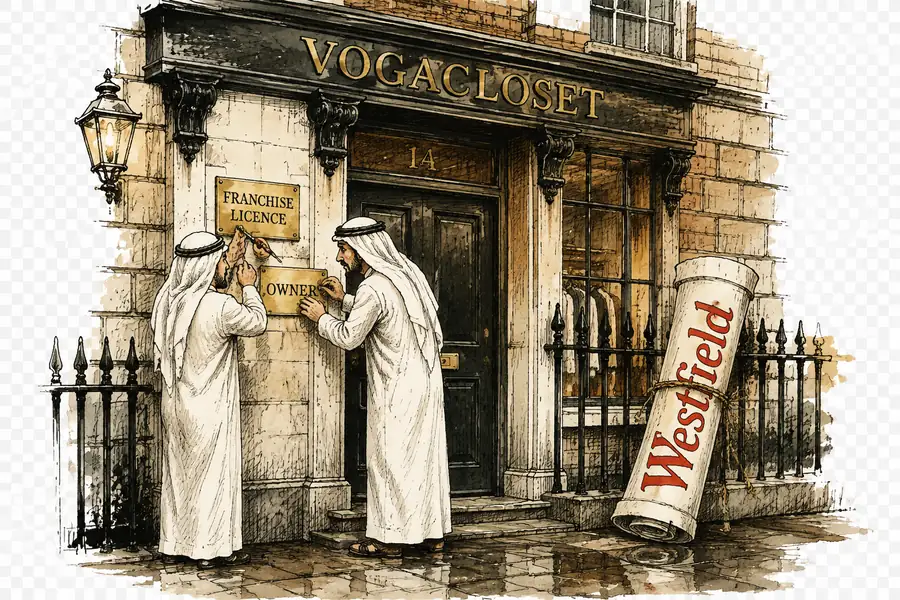
Riyadh Bought a London Platform Full of Saudi Customers
Two Riyadh retail groups took 51 percent of VogaCloset, a London-registered fast-fashion platform whose customers were already Saudi. Five years on, online is 8.6 percent of revenue and Dubai owns half the buyer.
Sir John Crabstone
The Gulf’s retail majors spent a generation as licensees, renting Western names by territory. In March 2021 two Riyadh companies stopped renting. Fawaz Abdulaziz Alhokair and Arabian Centres took a combined 51 percent of VogaCloset, a fast-fashion platform registered in London. They bought 41.2 percent of the existing shares at a $60 million pre-money valuation and injected $12 million more. It had twelve million users across the Middle East, over half of them Saudi.
The franchisee is trusted with the till and never with the assortment.
The company remains English on paper. VogaCloset Limited files from Berners Place in London and lodged its latest confirmation statement in February. What moved in 2021 was the margin, the customer file and the decision about what to stock. Riyadh did not buy a foreign market. It bought its own demand, incorporated abroad.
Gulf money in Western fashion is usually read as trophy-hunting: sovereign funds collecting European houses at the top of the market. This was the opposite trade. The asset was a distribution pipe whose worth lay in customers the buyers already served through their own shops, and the region had been quietly buying such pipes for years before the consultancies noticed.
One of the two buyers then went the other way. In May 2025 Arabian Centres, by now Cenomi Centers, took an exclusive Saudi licence for the Westfield name from Unibail-Rodamco-Westfield. The term runs ten years with an option on ten more, across up to eight of its centres. The same house bought a British platform and rented an American brand, four years apart.
The ambition was never hidden. E-commerce ran at roughly 10 percent of revenue in December 2022, when Cenomi’s chief executive Mohamad Mourad told AGBI he wanted the group “doing it because we’re the biggest e-commerce player in the kingdom”. Cenomi Retail carried 95 brands then, and a marketplace of its own was promised for the following year. It was a pledge made from a portfolio of other people’s names.
The Q1 2026 factsheet puts online at 8.6 percent of revenue. The brand count is 41. The document still opens by calling the company the leading franchise retailer in the Kingdom, and records that in January it changed its commercial name to AFG International. Five years after the platform was bought, online is a thinner slice of the business than when the pledge was made.
Then the buyer was bought. Al-Futtaim took 49.95 percent of Cenomi Retail in September 2025 for SAR 2.52 billion at SAR 44 a share, and lent a further SAR 1.35 billion on terms convertible into equity. A Dubai house now owns half of one of the two Riyadh companies that own the platform.
The handover was not a routine one. The Saudi regulator had referred seventeen people — former board members and a past chief executive among them — to the public prosecutor, alleging a false and misleading impression of the company’s value; Al-Futtaim says the conduct predates its stake. By June it had installed its own chief executive. The customer file Riyadh went to London to collect now reports to a board in the Emirates. The Gulf did stop franchising. It has not settled which Gulf keeps the customer.