Sephora Pays Two Dollars for a Shade Match
Sephora's gamified Beauty Insider Challenges pay a hundred points per task for behaviour that carries no purchase, which prices a shade match at roughly two dollars. The programme has quietly started collecting the signal its receipts never contained.
Sir John Crabstone
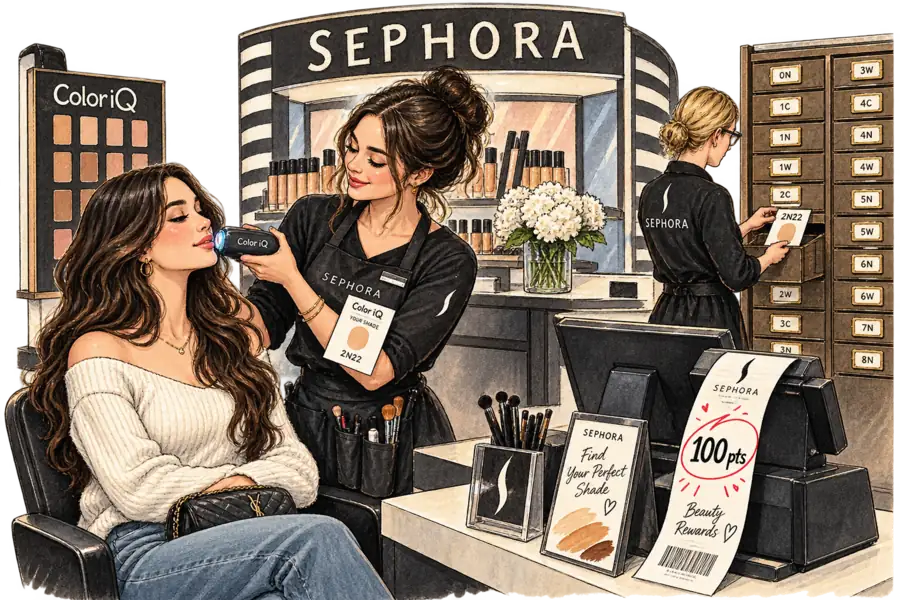
Sephora will pay a hundred points to learn your foundation shade. Its first Beauty Insider Challenge paid exactly that per task in 2023: sign up for text alerts, collect an order in store, add samples at checkout, sit for a Color iQ reading, as Glossy reported at the launch. Half of those required no spending, and the two that did rewarded the manner of the purchase rather than its size.
Five hundred points redeem as ten dollars of Beauty Insider Cash. The shade reading therefore cost two dollars; so did the phone number, though neither task alone clears the five-hundred-point floor needed to spend it. Two dollars buys a marketing channel that runs until somebody bothers to unsubscribe, and a shade record that sharpens every recommendation the retailer will ever make to that customer.
The mechanic has scaled well beyond its launch. Sephora counts more than 46 million Beauty Insider members, 30 per cent of whom have played at least one challenge since 2023, and Emmy Berlind, its SVP and general manager of loyalty, told Glossy this week the aim is to do more than just reward transactions. That is a candid account of what the transactions were failing to say.
The receipt was always the least interesting thing Sephora knew about anyone.
Purchase history is a poor teacher. It records the outcome and hides the deliberation: what was compared, what was abandoned, which shade was wrong the first time, which alert went unread until the third try. The challenge tasks are chosen because they leave a mark exactly where a receipt leaves none. A shopper who takes the colour match and the text alerts has handed over two things a decade of orders would never have disclosed.
The reason to collect them now sits outside the shop. Sephora’s app in ChatGPT answers beauty questions using “preferences from the customer’s Sephora Beauty Insider account profile,” provided the shopper has linked that account, by the company’s own account. The loyalty file has stopped being a ledger consulted at the till. It is the payload the retailer ships to whoever is currently holding the customer’s attention, not merely the one printed at checkout.
The trade reading of all this is competitive: Sephora is defending Gen Z against Ulta’s tiers and Amazon’s delivery, and the games are a retention device. Berlind said as much in the same interview, describing shoppers’ engagement as data on how to keep them in store, and calling it a virtuous cycle. That reading takes the points seriously as money. It should look instead at how seldom they are spent. Offered 250 points in place of a birthday gift, only a tenth of members take the points, Forbes reported in February. A rewards currency this rarely cashed out is not really a currency at all.
Sephora is buying permanent facts with a currency most of its holders never spend. Two dollars a shade is a bargain, and the shade goes on working long after the ten dollars it cost has been forgotten.