Tanner Fletcher's Cheapest Capital Is a Wedding Date
Wedding attire is now half of Tanner Fletcher's business, two years after the label's first bridal look. The occasion holds full price in a market trained to wait for markdown, which makes bridal the cheapest funding an independent designer will ever get.
Sir John Crabstone
Wedding attire now makes up half of Tanner Fletcher’s business. The label made its first bridal look in 2024 as a one-off, and Glossy reported the split this week. Most pieces sell for a few thousand dollars each, and the label struggles to keep enough in stock to meet demand.
Kasell has his own explanation, and it is about design, not economics. “There weren’t a lot of good options for people looking for something more interesting,” he told Glossy, describing a category where “everything has looked the same for decades.” That account is true. It is also not sufficient: interesting clothes get marked down in July like everything else.
The date does what design cannot. The Knot’s 2026 study of 10,474 American couples found 85 percent saying the economy had affected their planning. Of the couples who changed their budget, 77 percent raised it. Three in four said afterward that the wedding had been worth the money. Spending that rises when money tightens is not discretionary. It is an obligation.
Set the price against the national average. The same research puts a typical American wedding dress at about $2,100. Tanner Fletcher is charging well above that two years into the category, and the orders have not slowed.
Ready-to-wear has no such protection. Apparel discounts peaked at 25.1 percent off list last US holiday season, Adobe Analytics reported, against 23.2 percent a year earlier. Pricing software has spent years teaching the customer that the jacket will cost less in six weeks. No one has taught them to wait on the dress they get married in.
The incumbents reached the same conclusion by a costlier route. David’s Bridal came out of bankruptcy and routed checkout through ChatGPT and Copilot, as we covered in April. All that software exists to capture an occasion that was already inelastic. Two designers in a downtown showroom reached the same customer with a bow.
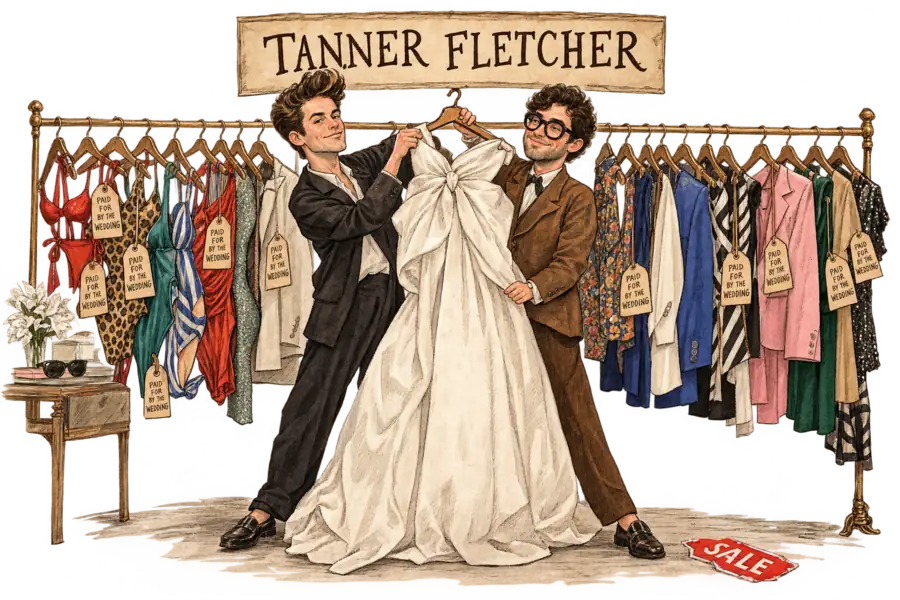
The channel mix follows the same logic. Wholesale has held near 20 percent; the rest is direct, where the prices are set. Glossy found swimsuits and funky tailoring on the racks at this month’s showroom presentation. None of it carries a date, and all of it depends on a customer who has already proven willing to pay full price for the piece that does.
Kasell told Glossy that scale depends on funding and that the label needs the right partner — one who will protect the vision, he said, “beyond anything else.” Even the ask comes with a condition attached.
Tanner Fletcher has not raised capital; it has borrowed a deadline that belongs to the customer.
An investor would be buying the design. The prices are being held up by a date on someone else’s calendar. That date will hold for anyone who turns up with a better bow. No designer has ever owned one.