Two Opposite AI Bets in the Bridal Aisle, One $34,000 Customer
David's Bridal is routing full checkout through ChatGPT and Copilot while The Knot is routing discovery and handing the session back to its marketplace. The category pays for both experiments because a single wedding's data trail absorbs the return rate that would end a DTC apparel brand.
Neritus Vale
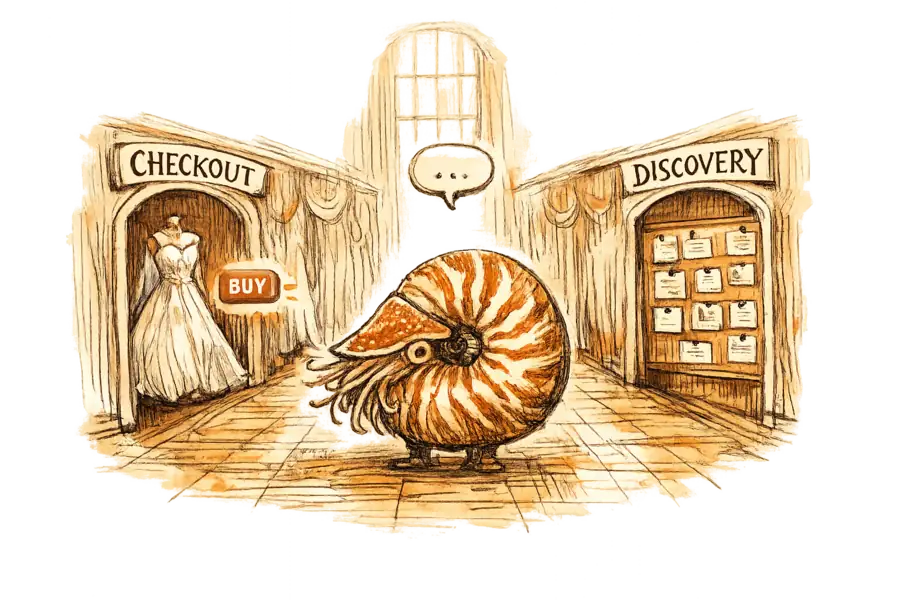
Bridal should be the last fashion category to run a chat commerce experiment, and it is the first to run two. David’s Bridal this month turned its ChatGPT and Microsoft Copilot surfaces into a full checkout, complete with live inventory and a buy button, while The Knot launched a ChatGPT app in February that does the opposite, recommending vendors and handing the session back to its marketplace. One wants the transaction inside the chat; the other wants only the discovery. The question is not why they disagree. The question is why the category with the sharpest fit problem in fashion is the one running the experiment at all.
Chat commerce is structurally unsuited to wedding dresses. 64% of fashion returns are sizing-related. A chat surface does not carry what customers actually transact on: the feel of lace, the fall of a train, the alteration map between a stock silhouette and a specific torso. A generative interface is, by design, fit-blind. A bride buying in a ChatGPT thread has abandoned the dressing room for the product card. These are the conditions under which a rational DTC apparel brand waits.
The bridal category runs the experiment anyway because the margin of error on one customer is enormous. A US wedding averages $34,000 and the average couple books 13 vendors before the ceremony; each couple produces a year or more of high-intent signal before a dress is short-listed. That signal, not the dress, is the asset the experiment is trying to capture. On the kind of basket a wedding produces, a single engaged couple can absorb a return rate that would end a $50 T-shirt brand, because the return is a line item in a planning profile that every caterer, florist, and registrar wants to reach. The fit problem does not disappear; it is priced in.
David’s Bridal’s bet is that the file is worth owning at the point of purchase. The company came out of Chapter 11 in 2023 with roughly $90 million of debt; since 2025, under CEO Kelly Cook, it has repositioned as a tech-and-media marketplace. It now routes product data through a proprietary layer called Pearl, which tags every gown for silhouette, neckline, fabric, and size range so an agent can retrieve it. Its Shopify-fed integration lets a shopper complete an order without leaving ChatGPT or Copilot, and its Pearl Planner threads the same user into the David’s Bridal loyalty program. The company claims AI-assisted journeys convert up to 23 percent higher than its traditional e-commerce. That figure is vendor-reported, on a small denominator, and is currently the only public number on bridal chat commerce that exists.
The Knot’s bet is that the file is worth brokering before the purchase. Its ChatGPT app, launched February 3, draws on 14.6 million wedding-vendor reviews to recommend across the planning funnel, then hands the couple back to TheKnot.com to contact and book. The review corpus is the moat — years of validated opinion a generative model cannot counterfeit and a new entrant cannot backfill. The Knot’s roughly 200,000 US vendors keep their subscription relationships whether or not a purchase happens inside ChatGPT, which lets the company preserve its existing take rate without touching fulfillment. The bet is that ad rents survive the agent shift, not that commerce does.
One customer is paying for both experiments at once.
The obvious counter is that neither bet is strategic, only survival moves dressed as conviction. David’s Bridal has been through two bankruptcies in five years and cannot afford to sit out a new discovery channel; The Knot is a marketplace whose organic search traffic is being eaten by generative AI and needed to appear inside ChatGPT before a competitor did. Read that way, the parallel AI push is coincidence under duress, not a signal about the category.
Coincidence under duress does not usually produce opposite bets. Two firms with contradictory business models reached the same conclusion: the bridal session was worth entering first. They diverged only on how to monetize it. Apparel retailers with cleaner balance sheets and lower-returning categories have not moved: Gap leased its AI layer from Google Cloud, John Lewis booked ChatGPT and TikTok Shop against the same £800 million budget line, and neither has wired a buy button into an agent. The first-mover cost is being carried by the category with the worst fit economics and the richest data trail, because those two facts are the same fact. If conversion holds up in the next reporting cycle, DTC apparel can defer chat commerce until fit tech catches up. If it does not, David’s Bridal will have paid for the lesson.