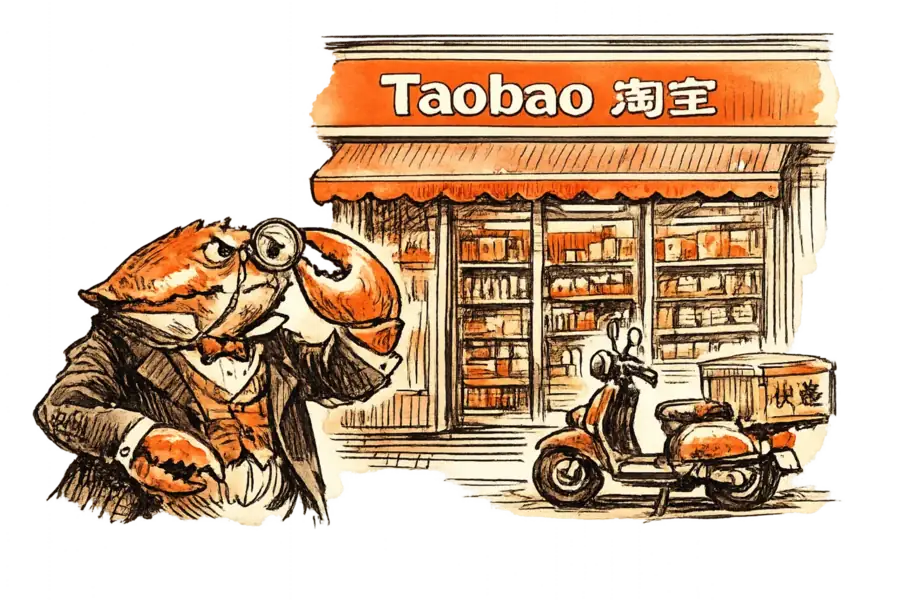
Taobao Opens Convenience Stores. The Moat Is Physical.
Alibaba's 2 billion yuan investment in Taobao-branded convenience stores signals that China's largest digital retailer now treats physical proximity as a defensible capability, not a legacy cost.
Sir John Crabstone
Alibaba is spending 2 billion yuan on convenience stores. Not buying them — branding existing shops across more than 200 cities, equipping them with supply chain tools from 1688.com, and requiring 24-hour operation with 30-minute delivery. The company that built China’s digital marketplace now treats a 10,000-SKU corner shop as strategic infrastructure.
The moat moved.
Most coverage frames this as a subsidy war. Alibaba’s quick commerce revenue grew 56% year-on-year to RMB 20.8 billion in the December 2025 quarter, but the China e-commerce group’s adjusted EBITA fell 43%. Read that as profligacy if you like. The investment is not in price — it is in physical position.
Meituan understood this first. Its non-food daily order volume has already passed 18 million, and the market still expects it to emerge dominant. Alibaba cannot replicate that network in software. So it is doing what platform companies rarely do: attaching its name to shelves in buildings it does not own.
The Taobao Convenience Store model works like a franchise without the contract. Authorized merchants operate under Taobao branding, draw inventory through Alibaba’s Aoxiang replenishment platform, and face strict standards on speed and accuracy. The first 34 stores launched across China in November 2025, with Hangzhou and Nanjing among the opening cities. Each stocks roughly three times the SKUs of a standard convenience store.
The model is lighter than Meituan’s. Dark stores are owned infrastructure with controlled inventory and salaried staff. Alibaba is betting that brand standards and supply chain integration can extract the same speed from independent operators. That bet has not been proven at scale.
The super-app thesis held for a decade. Distribution through software: one app, infinite categories, zero physical cost. Quick commerce broke it. A 30-minute delivery promise requires inventory within cycling distance — no algorithm fills that gap.
China’s instant retail market was forecast to exceed 1 trillion yuan by 2026. The war for it will be won in square metres.