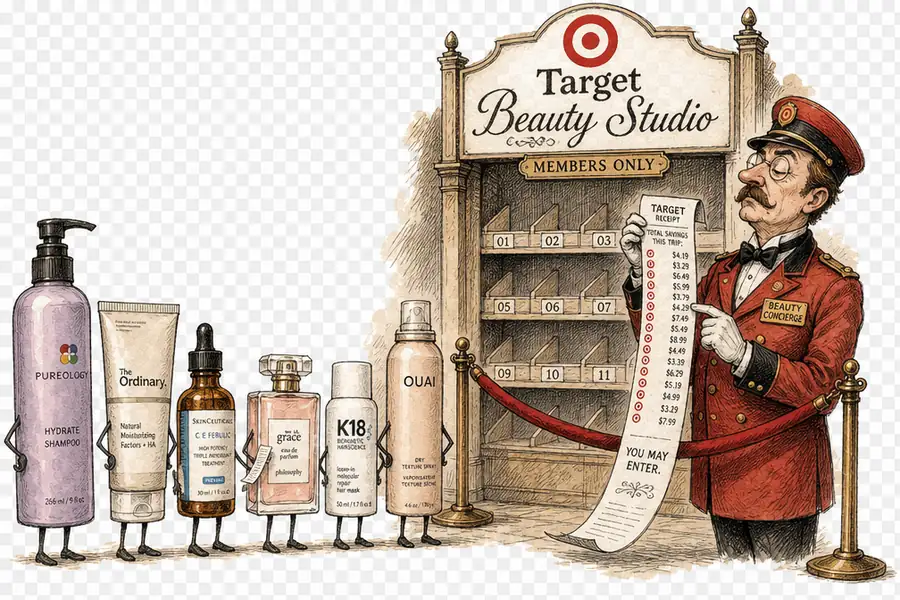
Target Filled 90 Beauty Slots With Brands It Did Not Find
Target Beauty Studio opens on 10 September with 1,600 products from 90 brands, two of them Black-owned. The intake test rewards brands another platform has already proved, which makes the shelf a portfolio of other people's verdicts rather than a discovery programme.
Sir John Crabstone
Target Beauty Studio opens on 10 September in more than 600 stores, carrying 1,600 products from 90 brands, more than two-thirds of them new to the retailer.
Two of the ninety are Black-owned. That ratio is not a statement of values; it is the readout of an intake test that rewards brands somebody else has already proved.
Target describes the assortment as prestige, emerging and global. The numbers founders gave Glossy define the middle word. Clearstem turned over $50 million last year, and Fur runs between $10 million and $20 million. Remilia Hair arrived with seven-figure Amazon sales behind it, and several brands were asked to supply the training videos Target’s own staff will learn from. Every one of them came with a receipt.
Target has built an incubator that admits only the hatched.
One name breaks the pattern. By the Beach Suncare launched less than a year ago and enters Beauty Studio on 250,000 units sold and a $4 million sales projection, tenure traded for velocity. The exception confirms what the rule actually measures: not age, but proof.
The two Black-owned names are Glamazon Beauty and Briogeo, as Modern Retail reported. Asked about the count, a Target spokesperson said nearly 40 percent of the ninety had “diverse” founders, and left the word undefined. A category that includes everyone measures nothing.
Briogeo has not been independent since 2022, when Nancy Twine’s company was acquired by Wella. The name on the bottle outlived the ownership behind it.
Wella passed into full private-equity hands in December 2025, when Coty sold its remaining 25.8 percent to KKR for $750 million in cash. One of Target’s two Black-owned beauty brands now sits inside a buyout portfolio. The count survives that; the claim does not.
Glamazon Beauty is the one that holds up, and it entered by the door everyone else used. In 2022 the makeup artist Kim Baker’s line became the first Black-owned beauty brand to launch on ShopHQ, a retailer that had already tested whether anyone would buy it. By the time Target came calling, the brand had years of sales data behind it — the same currency Clearstem and Fur spent to get in.
The complaint about the number is right and unfinished. Target used to work the other end of this pipeline. It pledged more than $2 billion to Black-owned businesses by 2025 and ran an accelerator for founders with nothing yet to show. That programme made candidates. A velocity filter can only sort them. The pledge had an end date, and it has passed; Target says it was met, and that most of those partners remain in place today.
A retailer that stops paying for trials must shop where the trials are already run. Amazon is one of those proving grounds — Remilia Hair built seven-figure sales there before Target added the line. That filter does not correct for who gets funded first, and Target has made itself the customer of its arithmetic. The next ninety are being graded now, on a platform it neither owns nor instructs.