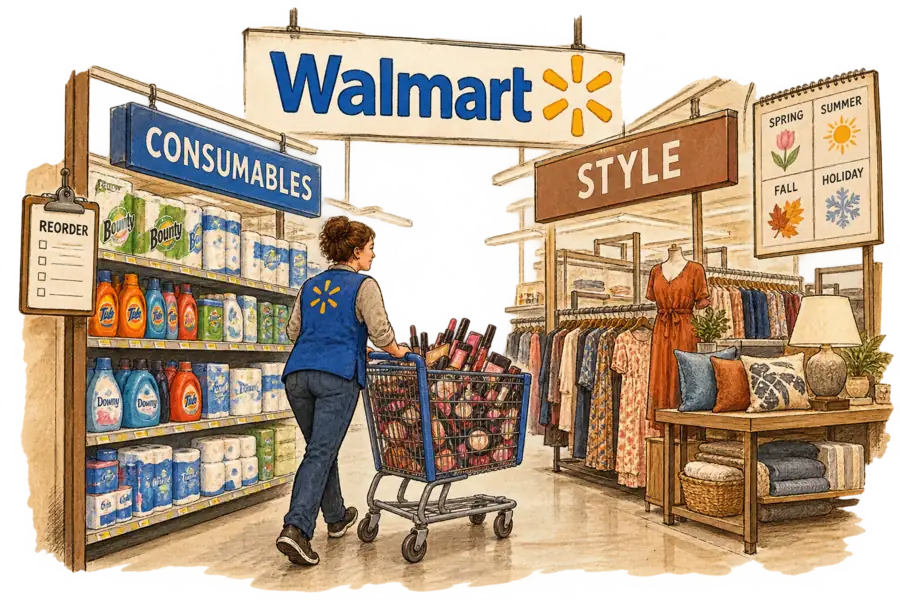
Walmart Filed the Lipstick With the Dresses
Walmart has moved beauty merchandising out of consumables and into a new Style unit with fashion and home. Beauty's test is whether a shopper who comes back for the same mascara still finds it on the shelf.
Sir John Crabstone
Walmart’s new style unit will be judged on its clothes and tested by its mascara. A memo from chief merchant Julie Barber puts fashion, home and beauty into one “Style Strategic Business Unit”, Retail Dive reported. Denise Incandela, executive vice president of fashion for Walmart U.S., will run it. Beauty merchandising moves across from consumables. In effect, it leaves the side of the store that is restocked for the side that is reset each season. Retail Dive placed the memo in Walmart’s long pursuit of fashion credibility. The clothes are the familiar part.
Walmart’s annual report for the year ended 31 January lists “health and beauty aids” among consumables, beside household chemicals and paper goods. They sit in a grocery category that sold $285.5bn in Walmart U.S. last fiscal year. A consumable earns its place by being there; nobody has praised a paper towel for its novelty. Style works the other way: a range that never changes has failed.
The memo reads as a verdict that a lipstick has more in common with a dress than with a bottle of bleach.
Vinima Shekhar, Walmart’s vice president of beauty, said as much in July. “We’re intentionally repositioning beauty as part of our broader style ecosystem alongside fashion and home,” she told Chain Drug Review. Over the past year, she said, Walmart launched 100-plus beauty brands, in store and online. Yet her pitch still rested on the staple: shoppers come for “their everyday needs” and discover beauty along the way. Beauty 2.0, the store redesign she describes, puts in-store beauty advisors in about 150 stores now and 300 more by the end of 2026. A mascara is a trend when it launches and a staple every time it is bought again.
The two sides of the store respond to price at different speeds, as Walmart’s chief executive described on the August earnings call. John Furner said that investment in price tends to bring “faster sales” in general merchandise, measured in dollars. In food and consumables, “you see units grow” first, and the “more lasting impact” arrives “over a few weeks, a few months,” once shoppers trust Walmart’s low prices across a basket of goods. He did not mention beauty, so which speed it follows is for the Style unit to find out.
The same call also covered the fashion side. Scoop and Free Assembly, two of Walmart’s private labels, posted “triple-digit comps”, David Guggina, who runs Walmart U.S., told analysts. The finance chief, John David Rainey, tied share gains from higher-income shoppers partly to the assortment, pointing to elevated brands such as Wonder Nation. That, he said, “was part of the reason that our inventory went up.”
A missing staple has cost Walmart shoppers before. Project Impact, launched in 2009, cut the number of items in Walmart’s stores. By April 2011, with loyal customers shopping elsewhere, Walmart said it would return about 8,500 items to its shelves, Talk Business & Politics reported. The returning items carried “It’s Back” flags. Paper towels and laundry detergent were due back within months; apparel would follow later in the year. In 2011, when Walmart had to win its shoppers back, the clothes could wait.
The memo does give inventory a senior post. Leslie Leonard moves into the unit as senior vice president of merchandising enablement, supporting inventory execution, Retail Dive reports. Nothing in the memo, as reported, says whether a sold-out shade will count as a hit or a hole.