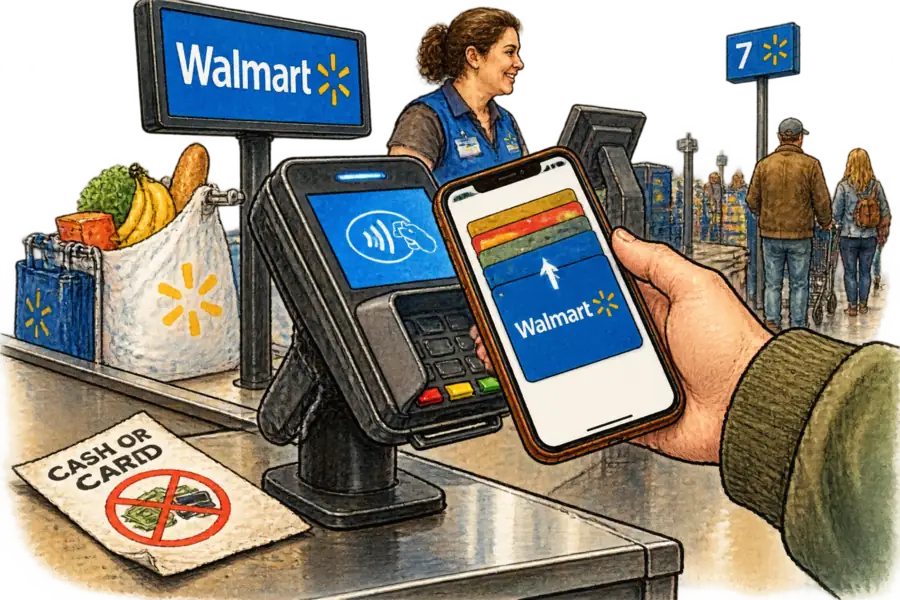
Walmart Refused the Wallet Until It Had a Card to Put in It
Walmart starts accepting Apple Pay and Google Pay on 24 August, ending almost twelve years of keeping NFC out of its lanes. The shopper data it defended at the terminal now reaches it through OnePay cards loaded into the same wallets it refused.
Sir John Crabstone
Walmart begins accepting Apple Pay and Google Pay on 24 August, almost twelve years after Apple Pay launched without it. The company’s own notice puts Tap to Pay in every US store and Sam’s Club by year end, and at fuel pumps by mid-2027. Walmart kept contactless out to protect its payment rails and the shopper data running on them. It is relenting because the wait at the lane now costs more than the data did.
Walmart led the Merchant Customer Exchange, whose CurrentC wallet drew straight from bank accounts to avoid the 2% to 3% the card networks charge. The consortium covered 110,000 locations and a trillion dollars a year in payments. Members signed exclusivity deals barring rival wallets; CVS and Rite Aid pulled support for Apple Pay soon after, which TechCrunch read as evidence of the exclusivity terms, not confirmation of them. The objection was never to tapping; it was to being written out of the transaction.
Walmart charged its shoppers a few seconds each and booked the proceeds as data.
That trade stopped clearing. Tap now runs nearly 70% of Visa’s American face-to-face transactions and more than 80% worldwide, chief executive Ryan McInerney told investors in January. A checkout that refuses the ordinary gesture stops looking thrifty and starts looking slow. Thrift the customer can feel is a cost.
The data did not have to be surrendered, only rerouted. Walmart-backed OnePay, valued above $4 billion in January, sells its own credit cards alongside Walmart’s; the same Tap to Pay announcement invites shoppers to load their Walmart, Sam’s Club, and OnePay cards alike into their digital wallets. The 2014 complaint was that Apple stood between Walmart and its customer; the 2026 answer is to put Walmart’s own products inside Apple’s wallet.
The rail Walmart has switched on is the one agents will use. Phil Philliou, a payments consultant, told American Banker that “the same tokenized, interoperable rail that lets a customer tap any wallet will let an AI agent check out on their behalf.” The same report offers a plainer account too: Walmart likely found a cheaper way to route these transactions than its own network fees, and shoppers had grown tired of waiting. A terminal that answers only to Walmart’s app answers to nobody else’s software.
Walmart has named the destination itself. Announcing the company’s Gemini deal in January, John Furner, then Walmart’s incoming chief executive, called the move from search to agent-led commerce “the next great evolution in retail”. You cannot enter that market with a lane only your own app can open. Walmart has moved its position from the till to the card. That holds until the software choosing the card belongs to somebody else.