Zara Signed Him in March. The Met's Nerve Lasted Thirty-One Days.
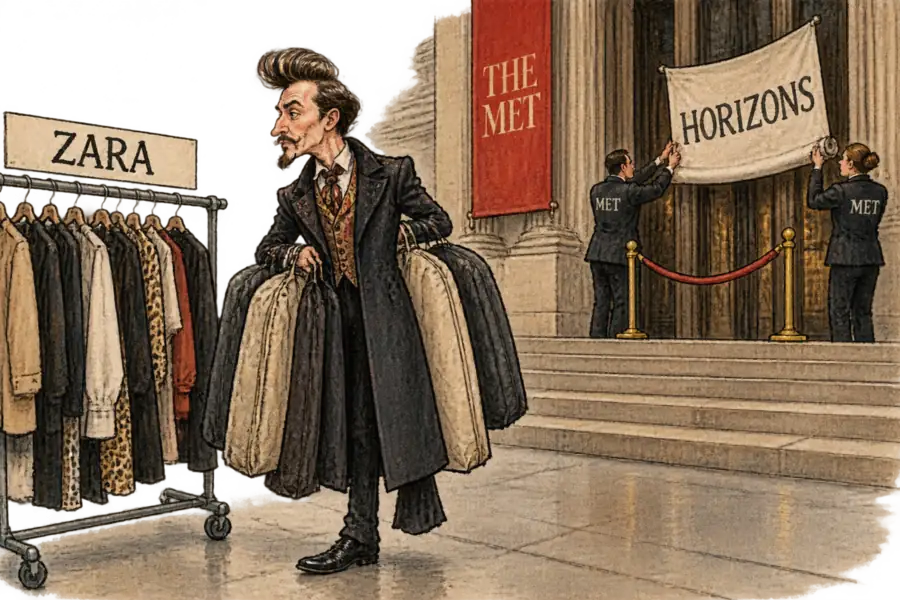
The Metropolitan Museum announced a John Galliano retrospective on 31 July and abandoned it on 31 August, five months after Inditex signed him to a two-year deal whose first collection reaches Zara this month. Commercial access and institutional endorsement are no longer running on one clock.
Sir John Crabstone
John Galliano’s retrospective at the Metropolitan Museum of Art lasted thirty-one days and never opened. Announced on 31 July, abandoned on 31 August. Fifteen years after a Paris court convicted him of public insults based on origin, religion and race, his rehabilitation has returned him to the shop floor but not to the museum. The industry has just watched those two clocks come apart.
The commercial clock finished its work long ago. Oscar de la Renta lent him a studio in 2013; Maison Margiela handed him a house in 2014; Inditex signed him to a two-year creative partnership this March.
At the group’s July annual meeting, chief executive Óscar García Maceiras told shareholders the first Galliano collection would reach shops from September. It arrives on the rails this month, at Zara prices.
He had already been inside the building. At the 2024 Met Gala, the party that pays for the Costume Institute, Maison Margiela dressed Zendaya and Bad Bunny and topped every label on the carpet at $40.8 million in media impact value, by Launchmetrics’ count. The museum was glad of his clothes on its steps. The vitrine was the part it could not manage.
Zara could price the risk of him; the Met could only carry it.
Glossy pinned the date: Horizons was to open on 3 May 2027, the evening of the Met Gala, which that year falls on Yom HaShoah.
New York’s City Council speaker Julie Menin called the plan “a gut punch to the Jewish community.” The museum had done the reputational arithmetic and skipped the calendar.
The objections that moved the building came with sums attached. The Art Newspaper reported, citing The New York Times, that Arne Glimcher, the gallerist who founded Pace, wrote to Max Hollein, the museum’s director, to warn that the decision’s cost had gone uncounted. He raised the prospect that he and his wife might reconsider leaving their collection to the Met. A letter is an opinion; a bequest is a number.
The Met never rescinded anything. Galliano withdrew on Instagram, deciding “with great sadness” that the exhibition should not go ahead; Hollein agreed this was “not the right time”; Anna Wintour called the withdrawal courageous. An institution that cannot afford to refuse a man in public can arrange for him to refuse himself. Everyone kept their principles and nobody kept the show.
Glossy read the cancellation as a fifteen-year rehabilitation meeting its limit, and counted Horizons as only the third solo Costume Institute show for a living designer.
Yves Saint Laurent had one in 1983, Rei Kawakubo in 2017. The two clocks run at different speeds because they count different things. A retailer buys a season and can drop the name next year; a museum has no such exit.
Seen as a sequence, the logic is plain: work restores standing, standing restores acclaim, acclaim ends in the archive. The last step is taken by people who were never his customers, and their consent does not respond to volume. Fifteen years of commercial evidence counted for nothing in August.
The Costume Institute holds the largest collection of Galliano’s work in the world, running from 1984 to 2024. None of it has moved. The museum will go on keeping the clothes. It has only decided not to be seen with them.