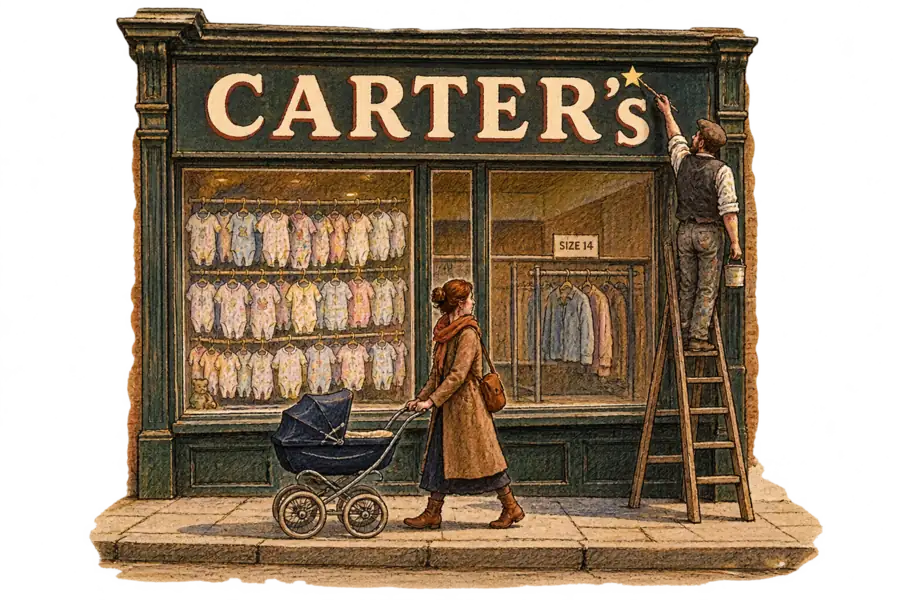
Carter's Met a Falling Birth Rate With a Shooting Star
Carter's first logo change since 2000 arrives in a year when American births fell again. The refresh is a bid for tenure inside a shrinking cohort: the brand holds about 21% of what Americans spend dressing babies and about 2% of what they spend on five- to ten-year-olds.
Sir John Crabstone
Carter’s has put a shooting star where its apostrophe used to be. The 161-year-old children’s brand unveiled a new logo this week, alongside a promise to “let every child’s light shine” and a sixty-second film called “Watch Them Glow.” The mark is new; the arithmetic behind it is not. America keeps producing fewer babies, and a company that dresses them must find growth somewhere other than the birth count.
American births fell 1% last year, to 3,606,400, and the fertility rate slipped to 53.1 per thousand women aged 15 to 44. A childrenswear customer is born, not persuaded. We watched the same subtraction close some sixty Okaïdi shops in France in May.
Carter’s says this where it is obliged to. Birth rate fluctuations “can have a material impact on consumer spending and our business,” its annual report warns, because they affect “the number of customers that are acquired and retained.” Declining birth rates open the list of challenges the company says it is stabilising against; tariffs come last. The campaign is addressed to parents; the filing, to owners.
The same document names the instrument. Marketing money, it says, goes to “acquiring new customers, developing stronger relationships with our existing customers, and extending our customers’ tenure with our brands.” Tenure is the word to keep. Carter’s brands take about 21% of what Americans spend dressing babies and about 2% of what they spend on five- to ten-year-olds; blended with OshKosh, the company-wide figures run lower, near 9% and 1%. The rebrand targets the Carter’s-brand numbers, and the growth it needs sits in the years it currently loses.
A children’s brand cannot make more customers; it can only hold the ones it has for longer.
The second quarter already reads that way. Net sales rose 5.2% to $615.5 million, with U.S. retail comparable sales up 5.1% while the retail segment itself grew 1.7%. Comparable sales count only the shops still open. Guidance calls for 2% to 3% growth against $2.898 billion last year, while the cohort beneath it contracts.
Trade coverage filed the refresh under generational taste. Modern Retail, which walked through it with chief marketing officer Sarah Crockett, reported the rebrand as Carter’s first logo change since 2000, alongside 150 store closures and 300 job cuts over three years. Crockett describes updated elements that “really speak directly to the Gen Z, young, millennial audiences and the values that they care about.” Values cost less to refresh than a store fleet, and they photograph better.
The evidence for the new parenting mood is slimmer than the campaign implies. Carter’s cites Pew’s finding that 44% of American parents are raising their children differently than they were raised; the same survey found 43% raising them the same way — fieldwork from 2022, three years before the campaign borrowed it. A brand may build on a coin toss if it likes. Every customer it has will outgrow it anyway; the new logo is an argument about when.