Glossy's Leaders Dinner Demoted AI. The Quarterly Has Not.
At Glossy's closed-door Leaders Dinner, the conversation quietly traded AI deployment for hiring community managers, shortening guest lists, and paying for windows. The press release has not noticed.
Sir John Crabstone
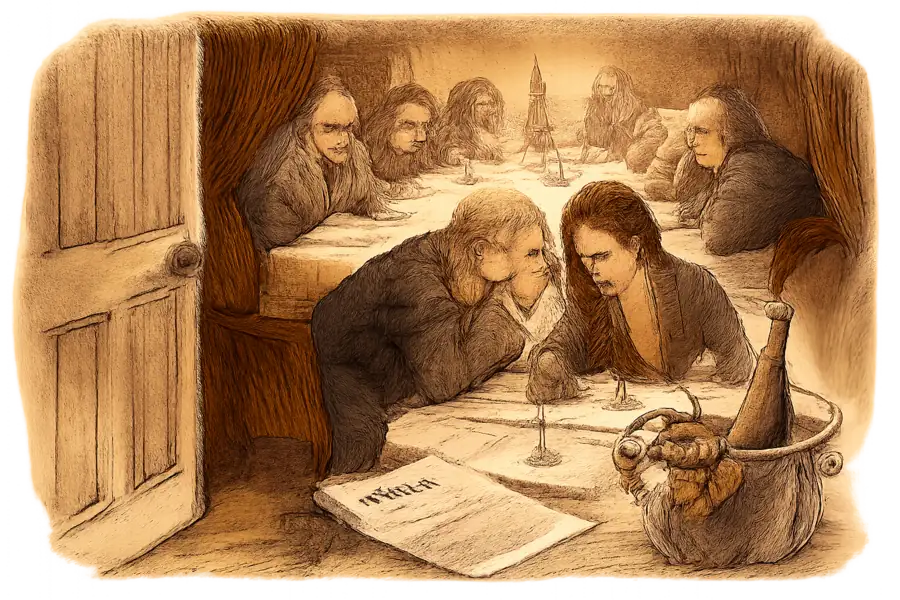
The most candid sentence in retail this month was uttered in a private dining room, under the Chatham House Rule, and reported by Glossy: “I cut my digital budget in half and hired two community managers.” The speaker is unnamed; the heresy is general. At the Leaders Dinner, the C-suite quietly stopped arguing about how to deploy AI and began comparing notes on how to grow without it.
That is the gap worth tracking. Press releases still pledge agents, models, and ¥380 billion of capex, as we reported earlier today. The boardrooms have not stopped funding the AI line; they have started funding the line the AI line was supposed to make redundant.
The dinner produced five quiet heresies.
First, Google and Bing no longer work as discovery channels the way they once did. Commerce sites are being rewritten twice: once for AI agents who do not browse, once for humans who no longer search the same way. The work is real but it is not growth — it is rent paid to a new landlord.
Second, paid digital is breaking against its own price floor. One executive cut digital in half and hired two community managers. A community manager is the last line of defence against your own funnel.
Third, stores have been re-classified as marketing. The honest version, supplied by an attendee: “my windows are my marketing, and our stores are marketing.” Translation: the e-commerce data said the market was ready, the lease was signed. Sales arrived slower than expected, and somebody had to make a virtue of the square footage.
Fourth, events have shrunk. The activation that drew hundreds of RSVPs lost the room; the dinner of twenty kept it. Luxury, and the brands now styling themselves luxury-adjacent, have rediscovered the salon.
Fifth, the channels that grow are the ones the dashboard can count. Livestreams, TikTok Shop, Amazon, Rakuten, AmEx offers, the second-tier creator on ShopMy or LTK who outsells the first.
What unites the five is unflattering to the prevailing narrative. AI was sold as the productivity layer that would let retailers run leaner and discover further. Inside the room, the same retailers are hiring people, shortening guest lists, and paying for windows.
The dinner is what the company believes.
The honest reading is that AI investment has not failed inside these brands; it has been quietly demoted. It remains essential for surviving the collapse of search, for filing the press release, for satisfying the analyst. It is largely irrelevant to whether next quarter’s revenue arrives. What the room produced was a list of pre-2015 levers, rediscovered.
One should not be surprised. Every cohort of executives is required to declare its faith in a technology and then, when no one is listening, build its plan around something older. The press release is for the analyst; the analyst is for the multiple; the multiple does not poll the staff.
The line worth keeping is the one an attendee offered without irony: you cannot replace the human touch. The brands reciting it most fervently are the ones whose pitch decks promised, eighteen months ago, that they could.