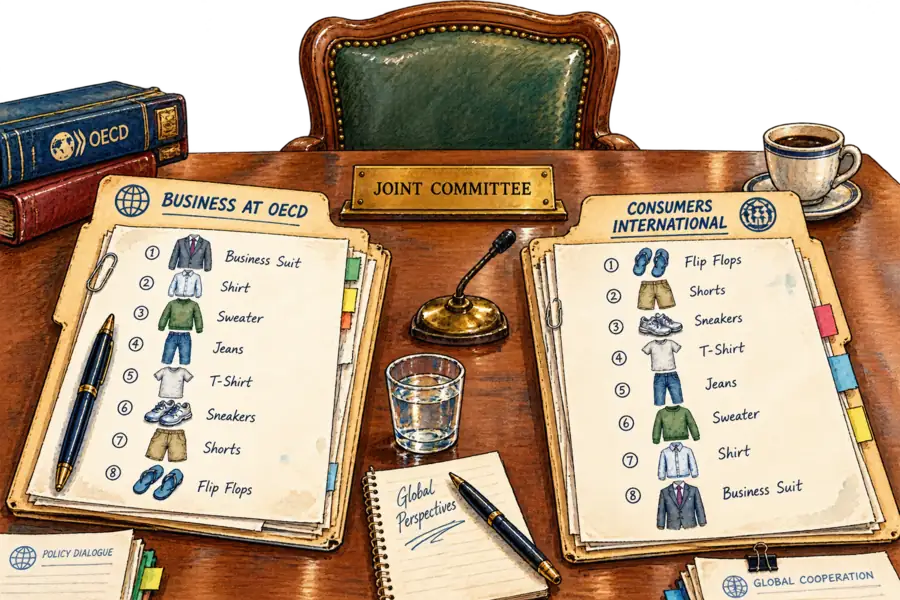
The OECD Asked Who Controls Ranking. The Answers Arrived in Opposite Files.
Business and consumer submissions to the OECD's June roundtable define platform ranking as opposite things: one a commercial judgment, the other a market power. That unsettled definition is what fashion will be regulated under once ranking moves inside an assistant.
Sir John Crabstone
Two submissions to the same OECD roundtable describe platform ranking as different objects. One treats the order of search results as a commercial judgment that competition law should touch only on proof of harm. The other treats it as gatekeeper power that ought to be constrained before the harm arrives. The Competition Committee met in June and adjourned without deciding which it is.
Business at OECD filed the case for restraint: competition law should step in only once harm to competition is shown, leaving deceptive or manipulative design to consumer authorities under their own regime. Overlapping concerns, in this account, do not justify overlapping enforcement. It is an argument for keeping two doors, filed by the party that would otherwise have to walk through both.
Consumers International reported the opposite instinct from its member organisations. Ex post antitrust moves too slowly and too narrowly to check gatekeeper power, so the rules need to be written in advance; competition, in this view, cannot be treated as separate from consumer protection. The boundary business wants preserved is the one consumer groups have identified as the gap.
Denmark’s competition and consumer authority draws the test the rest of the piece turns on: self-preferencing is a matter of process, not outcome, meaning whether a product’s prominence was earned or handed to it. Designated gatekeepers face an outright ban; everyone else, short of dominance, owes only disclosure. The test is precise, and it holds only while an outsider can watch the process.
The watching is not going well. In the authority’s 2024 survey, 45% of Danish businesses selling through marketplaces found ranking practices unclear. Disclosure obligations have applied since the P2B Regulation took effect on 12 July 2020; four years in, fewer than half the businesses bound by it can read the rules.
The OECD’s own background note concedes the difficulty without appearing to notice it, observing that the choice of enforcement framing “may depend on legal and strategic considerations rather than on the nature of the behaviour itself.”
The same note has already named the structure. Platforms that run a marketplace and also deploy an AI agent face “inherent conflicts of interest, creating incentives for self-preferencing in how agents rank, recommend or transact.” Naming a conflict is the easy half. The OECD does not say who would ever see this one.
A chatbot publishes no list. It reads the query and returns an answer; the ranking behind that answer never surfaces the way a search page’s did. Rules drafted for a numbered page have nothing left to attach to. The standard of proof survives; the proof does not.
Zalando is not a designated gatekeeper, so on ranking disclosure it sits in the second tier described above, not the outright ban. A separate case shows the same opacity problem under a different statute. Dismissing Zalando’s challenge to its designation as a “very large online platform” under the Digital Services Act a year ago this week, the General Court recorded a useful fact: among 83 million monthly users, the company could not distinguish those exposed to third-party sellers from those who were not.
A platform that cannot say which shoppers met a rival cannot be audited on whether it favoured itself over one. Brands signing marketplace terms this season are signing under a word two OECD contributors define differently. That definition will be settled while ranking is still a list on a page. It will be enforced, years later, against a system that shows one product and explains nothing.