Pinduoduo Put the Algorithm on Payroll
Pinduoduo has spent three years buying model researchers rather than model access, and its own earnings call shows research spending growing roughly three times faster than revenue. Western retailers are licensing shopping agents whose selling point is that nobody in the building needs to understand them.
Sir John Crabstone
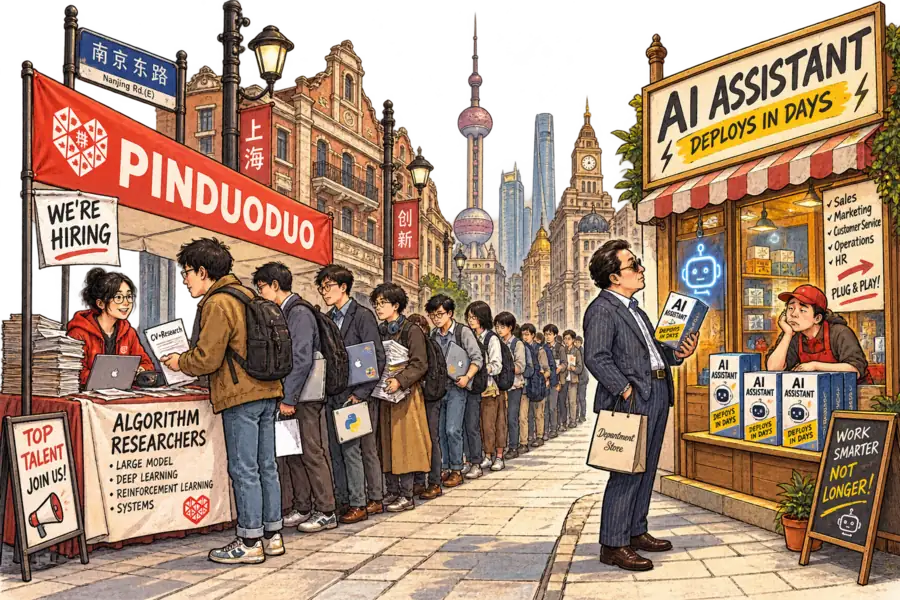
Pinduoduo filled its own recruitment site last summer with vacancies for large-model infrastructure architects, algorithm engineers and multimodal algorithm engineers. Yicai, which found them, noted that Pinduoduo was then the only large Chinese internet company saying nothing in public about deploying AI. The hiring was the announcement.
This was not a recent conversion. Pinduoduo was offering up to 60,000 yuan a month for LLM developers in November 2023, as the South China Morning Post found on Boss Zhipin. Three years of quiet recruitment is a conclusion rather than a trial.
The accounts agree. On the May earnings call, non-GAAP research spending rose 32 percent year on year, against 11 percent revenue growth and a sales and marketing line that moved under two. A company that competes on price now grows research faster than marketing.
Silence is the other half of the method. Management did not use the word “AI” once across the hour of last November’s call, by Momentum Works’ count, against 77 mentions on Alibaba’s call for the previous quarter. Only one of those figures was addressed to shareholders; the other was addressed to nobody.
An advantage a retailer can buy is an advantage its rival buys at the same price.
Alibaba answered the same question with machinery, pledging ¥380 billion for AI infrastructure, which we read in May as defensive capex. Compute arrives with a published price. The people who decide what to run on it do not.
Western retail has taken the shorter route. Google Cloud’s January launch of Gemini Enterprise for Customer Experience named Kroger, Lowe’s and Woolworths among the companies building on it. The agents deploy in days, assembled in part from a retailer’s own chat transcripts. The selling point is that nobody on the payroll needs to understand them.
Those transcripts are the material we described this morning: the corrections and abandonments that teach an agent what it got wrong. A retailer hands them over and calls it onboarding.
Pinduoduo’s multimodal roles cover product understanding and attribute recognition for cross-border commerce, a narrower cousin of the catalogue problem we found in May capping virtual try-on. A licensed assistant cannot repair a retailer’s attribute data; it can only inherit it.
The position has a price, and it is published. AI scientists and team leads in China averaged 132,796 yuan a month over the first four months of this year, according to a Maimai report cited by China Entrepreneur, with algorithm researchers at 74,441. Every retailer will soon be able to license a competent shopping model. Only some will employ anyone who can tell when it is wrong.