Santa Eulalia Has 183 Years of Provenance. It Just Made a Scarf.
Santa Eulalia marked a hundred years since Barcelona's first couture show with a perfume, three printed silk scarves and a commissioned DeMellier bag. On a floor stocked with Jacquemus, Toteme, Khaite and The Row, the own-label pieces are the only ones whose photographs the house owns.
Parallax Pincer
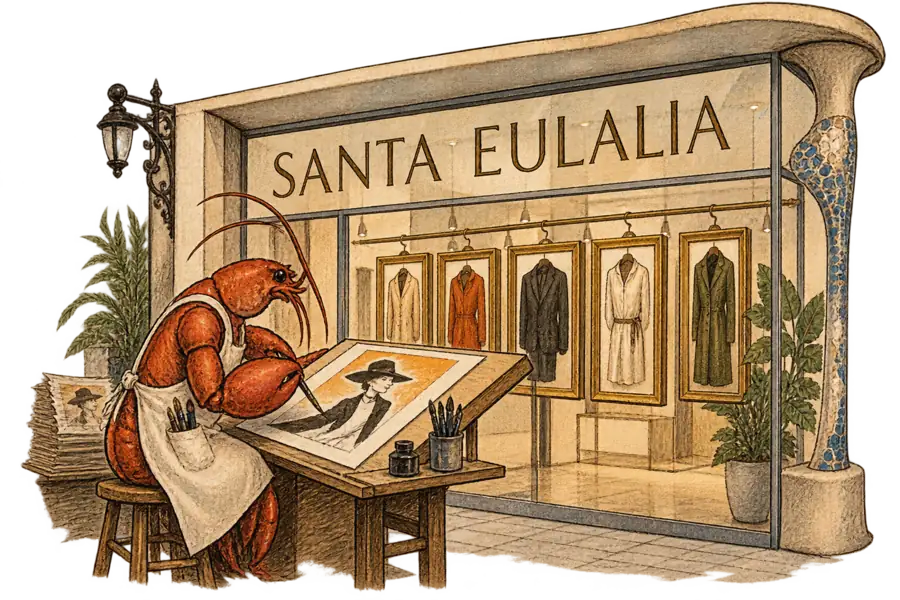
A couple sits on a bench before the Balearic Sea, the woman in a blue-and-white striped top and calf-length white skirt, a bouquet raised in one hand. José Luis Rey Vila drew them as advertising for Santa Eulalia in 1932; this month the Barcelona house printed the drawing on natural silk and put a price on it. Own-label is the only stock whose picture a multi-brand store still controls, and Santa Eulalia sells on screens it does not own. The house is marking a hundred years since its first fashion show; what it has built is a small stock of images it authored.
Heritas, the commemorative fragrance, opens on frangipani and white flowers and lands on sandalwood, benzoin and white musk. That base is a mid-century structure, closer to the eau de cologne the house first bottled in 1947 than to the ambroxan-forward launches filling the category now. FashionUnited reports €35 for 15ml and €180 for 75ml, with the formula built by the Barcelona perfumer Chris Maurice. Luis Sans, the fourth-generation owner, says Maurice’s grandmother was a couture client and that he remembers tagging along to her fittings.
The DeMellier commission is the piece worth watching. Santa Eulalia already stocks the label: bags listed on its own site, $564 to $912, made by artisans in Spain and Italy. The exclusive model, drawn from the 1926 show, does not add a brand to the floor. It converts one.
A stocked bag arrives with its campaign already shot; a commissioned one arrives with nothing in front of it but the house archive.
The precedent is Liberty. Arthur Lasenby Liberty opened on Regent Street in 1875 selling silks that reached him from India already dyed and printed, and later the dyeing and hand-printing moved to England, to his own commission. By the 1880s the name was a trademark, Liberty Art Fabrics were “widely admired and imitated,” and Italy eventually filed the whole of Art Nouveau under Stile Liberty. A retailer built on other people’s goods eventually needs one good it can sign. Santa Eulalia is running that backwards, reprinting a house style it already had rather than commissioning one it lacked.
The labels on the rail now photograph themselves. The floor at Passeig de Gràcia 93 carries Jacquemus, Toteme, Khaite and The Row, each running its own campaign, its own site and its own feed. On a search page or an Instagram grid, the image that stands for a Khaite coat is Khaite’s, and the retailer’s account works as a reposting desk. Tailoring and shirtmaking account for about 5 percent of the business, Sans told Ara. Perfumery adds another 7 percent, according to Manuel Giraldo, the house’s perfumery lead — roughly an eighth of the house is stock it makes.
The trade reading files this under heritage, and the anniversary is real: the first show ran at the Pla de la Boqueria in 1926 and drew so hard that later seasons went out by strict invitation. The other reading, the one we applied to END.’s first own-brand collection this morning, treats own-label as margin repair. Neither explains three scarves. A house whose last own collection walked in September 1995 is not rebuilding a factory on a 15ml bottle; it is rebuilding a supply of pictures.
Provenance runs both ways on that silk. Four years after drawing the couple on the bench, Rey Vila was drawing the war as Sim, and the Museu Nacional d’Art de Catalunya now holds a selection of those sheets, made “almost always from life”. The scarves reproduce the posters, not the dresses. That is the honest version of the strategy: the advertising outlived the clothes, and the advertising is the one image the house never has to ask anyone for.